The Sky at Night
Our team of astronomers tell us what's on view in the night sky. From comets to quasars, there is always something fascinating to discuss in the Universe.
Our team of astronomers tell us what's on view in the night sky. From comets to quasars, there is always something fascinating to discuss in the Universe.
The team explore Nasa's Artemis II mission, the first crewed journey towards the moon since 1972. They also look into robotic landers and new scientific clues from lunar samples.
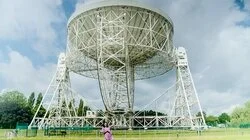
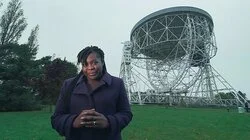
The team explore the remarkable story of Jodrell Bank Observatory and its towering Lovell Telescope, which scientists have used to listen to the cosmos for almost 70 years.
The team explore one of the biggest stories in space news, the ‘city killer' asteroid 2024 YR4. How well did the planet respond to this potential natural disaster?
The team explore what the latest research is revealing about Mars. Could life have once thrived there? And will a return trip to our neighbouring planet ever be possible?
The team celebrate the 350th anniversary of the Royal Observatory, recreating history at a special dinner party, where they are joined by a glittering line-up of science communicators.
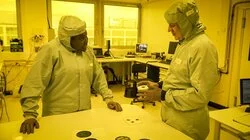
The team go on a cosmic adventure, exploring one of the newest areas of modern astronomy – the search for exoplanets, the distant bodies that orbit stars beyond our own solar system. These strange new worlds are transforming our understanding of how planets form, where we can look for potentially habitable ones and just how unique, or not, our own Earth may be.This captivating new field intrigued presenter George Dransfield so much that she left her secure teaching job to go back to university to study for a PhD, and so she was thrilled by the opportunity to travel to Germany, where ESA's Plato spacecraft is being built. This cutting-edge mission will study exoplanets like never before. Dubbed 'the planet hunter', Plato will use its 26 cameras to scan over 2,000 sun-like stars to search for rocky Earth-like planets. With each camera capturing 81.4-megapixel images, the resulting two-billion-pixel overall view will be the largest ever for a space mission. George meets ESA's Thomas Walloschek and OHB's Pablo Jorba Coloma, to talk about the engineering challenges they have overcome, before going to see the space craft in the clean room where it is being built.Back in the UK, Chris Lintott takes us on a quick tour through 30 years of exoplanet discovery and shares a possibly endless list of the strange new worlds that have been found. He also meets Dr Edward Bryant, from the University of Warwick, whose recent discovery of planet TOI-6894 b was published in June. This Saturn-sized gas giant, orbiting a tiny red dwarf star, defies current models of planet formation and raises new questions about how such massive planets can form around such small stars. Could our models be missing something fundamental?Meanwhile, Maggie Aderin-Pocock explains the mystery of the exoplanet Radius Valley - with the help of some sweets, of course! She then speaks to Larissa Palethorpe, whose PhD research in this area led to the discovery of Gliese 12 b, the closest Earth-sized planet in the habitable zone found to date.As ever, Pete Lawrence is on hand with practical stargazing tips for the summer months, including how to spot and photograph the 'moon illusion' - an optical trick that makes the moon appear unusually large when it's near the horizon. With the moon sitting low in the sky during this phase of its 18.6-year cycle, it's the perfect time to try capturing this stunning effect.Finally, we conclude this episode with a celebration of Chris Lintott's 25 years since his first appearance on the programme.The strange new worlds being uncovered through exoplanet research offer a rich and thought-provoking glimpse into the incredible diversity of planets across the universe and prompt us to consider just how rare, or common, our place in it might be, and this programme takes you on a journey to explore them from the comfort of your own sofa!
The team delve into the enigmatic world of pulsars and hear the inspiring story of their discoverer, Dame Jocelyn Bell Burnell, direct from the subject herself.
The team explores one of the greatest discoveries of modern astronomy that our universe is expanding, and the new questions it raises about how the cosmos works. Maggie Aderin-Pocock investigates a different cosmic speedometer.
The team delve into the world of astronaut training, discovering what it takes to become a European Space Agency astronaut. With special guest Helen Sharman.
In a spectacular season finale, the team are joined by Hannah Fry and Dara Ó Briain in front of a live studio audience to answer viewers' burning queries about space.
 E1
E1
The Sky at Night team delve into Nasa's OSIRIS-REx mission and find out what it takes to analyse the tiny pieces of space rock that may tell us about the origins of life.
 E2
E2
The Sky at Night team looks at how scientists are creating eclipses on demand to discover the hidden secrets that might be revealed, including habitable planets like our own.
 E3
E3
The Sky at Night team go cosmic ghost-hunting, looking for hidden objects across the universe that we can't see, but which astronomers and scientists still believe are out there.
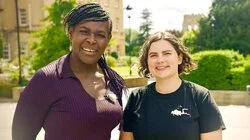 E4
E4
The Sky at Night team mark the second anniversary of the release of the first images from the James Webb Space Telescope, finding out what it has told us so far.
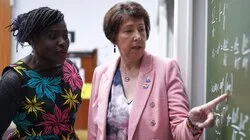 E5
E5
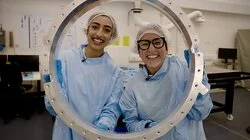
In this Sky at Night special, the team talk to Dr Nicola Fox, NASA's head of science, whose life began in the UK. Presenter Chris Lintott chats to Nicky about her early years growing up in Hitchin in Hertfordshire and discovers how she fell in love with the stars. Maggie Aderin-Pocock takes Nicky on a trip down memory lane. Both women studied physics at Imperial College London from the late 80s to early 90s. As they revisit familiar haunts, they discuss their experiences, and Maggie finds out about Nicky's love of astrophysics, the challenges she overcame and how she landed a dream job at NASA.
 E6
E6
The Sky at Night is embarking on a journey into the future, as we explore how space will revolutionise life on Earth over the next 50 years. As humanity's reach extends into the cosmos, we face unprecedented challenges, from redefining what it means to be an astronaut, to confronting our own space junk, to dealing with the impact of life in space on our earth-adapted bodies. With privileged early access to a groundbreaking new report from the Royal Society on humanity's future in space, the Sky at Night team are on a mission to find our destiny among the stars – our place in space.
 E7
E7
Get ready for The Sky at Night's annual Question Time Special, where viewers get the opportunity to ask the questions they have always wanted answered about our universe. Join host Dallas Campbell as he leads a panel of experts through a range of fascinating topics.Regular presenters Maggie Aderin-Pocock, Chris Lintott and George Dransfield are joined by Prof Raman Prinja from University College London and Dr Heloise Stevance from Oxford University. Resident astronomer Pete Lawrence also makes an appearance, sharing a guide to the stars for the coming months and posing an intriguing question of his own.This year's discussion covers subjects such as the nature of the oldest galaxies – what we're seeing and how we know they're so ancient. We delve into the search for habitable Earth-like planets and the effects of the stars they orbit. And we explore what might happen to Earth and our planetary neighbours when our sun begins the end of its life in billions of years' time.
 E8
E8
The Sky at Night teams up with BBC Ideas to discover the secrets of archaeology and astronomy and to reflect on our ancestral skies. Throughout history and across the world, humanity has looked up and marvelled at the night sky. From ancient civilizations who were guided by the sun, moon and stars, to modern astronomers uncovering the universe's history, we have always found deep meaning in our dark skies. But is modern civilisation putting this important link at risk?
 E1
E1
The Sky at Night team investigate the latest science used in the hunt for extraterrestrial life, including a major mission to Jupiter's icy moons.
 E2
E2
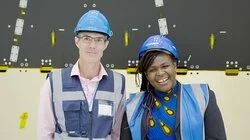
The Sky at Night team explores the threat of an asteroid impact on earth and meets the space scientists who are developing methods of planetary defence that sound like the stuff of science fiction.
 E3
E3
The Sky at Night team investigates the science and engineering helping the UK to blast into space. Chris visits a rocket company near Glasgow to find out how rockets are built.
 E4
E4
The team investigates the controversial world of alien communication. If we discover aliens, how would we contact them, and should we communicate with them at all?
 E5
E5
The Sky at Night team investigate the science of black holes and discover the incredible techniques being used to uncover their secrets.
 E6
E6
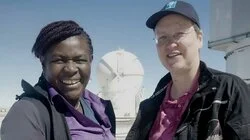
The Sky at Night team travels to the heart of Chile's Atacama Desert to explore one of the most advanced observatories in the world - the Very Large Telescope, or VLT.
 E7
E7
A special Question Time edition of the programme, recorded at the University of Exeter as part of the British Science Association's Science Festival.The panel is chaired by science journalist Dallas Campbell and made up of The Sky at Night presenters Chris Lintott, Maggie Aderin-Pocock and Pete Lawrence, who are joined on stage by Dr Claire Davies, who studies star and planet formation, and Dr Hannah Wakeford, who specialises in the atmospheres of exoplanets.The panel answer questions covering all things astronomical from The Sky at Night's avid viewers and from audience members. We also hear about updates from the Voyager missions to life on other planets and discover where the panel would want to send future space probes if they had the chance.
 E8
E8
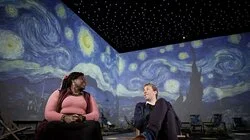
In a special episode to mark the end of another season, The Sky at Night teams up with Radio 4's The Infinite Monkey Cage to talk all things amateur astronomy.
 E1
E1
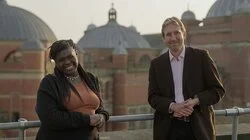
The Sky at Night team explore how light pollution impacts the beauty of the night sky, animal behaviour and human health, and what might be done to mitigate its harmful effects.
 E2
E2
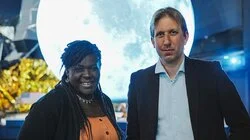
The Sky at Night team report on the new scientific methods being used to detect exoplanets and how the winter darkness of Antarctica is critical to their success.
 E3
E3
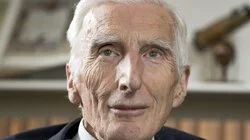
2022 marks the fiftieth year since an astronaut last stepped on the moon's surface. We look back at the legacy of the Apollo programme and forward to the future of lunar exploration. Maggie and Chris visit the Science Museum in London, where Maggie discovers from space curator Doug Millard that one of the museum's star attractions – Apollo 10's command module – nearly did not make it back to Earth.Chris discovers that Nasa's latest assault on the moon, the ‘Artemis' programme, plans to set up an orbiting moon station and a shuttle from it to a permanent base on the moon's surface, and learns from Nasa's Dana Hurley that much of the technology needed for such a mission has yet to be invented. Nonetheless, the first dry run for the SLS rocket and the Orion command capsule and moon landing system will go ahead without a crew and is planned later this year. On that first mission to orbit the moon, 13 tiny ‘cubesats' will be released into the moon's orbit to discover more about the lunar surface in anticipation of greater future human activity on the moon. These low-cost satellites are providing the next generation of space scientists and engineers an opportunity to work on spacecraft for the first time.Maggie talks to Craig Hardgrove, an associate professor from Arizona State University, who leads a relatively inexperienced team in building LunaH-Map. The pint-sized craft will scan the lunar surface for evidence of hydrogen, and therefore water, which will be enormously useful for future missions and moon bases to provide sustenance and fuel – once the technology is in place to deliver it.Pete Lawrence is on hand for tips on how best to observe the moon from Earth during the upcoming lunar eclipse on the 16 May, and Chris learns from Professor Sara Russell of the Natural History Museum that the Apollo missions allowed science to identify moon asteroids here on Earth, and that future missions retrieving more moon rock might tell us even more about how the Earth formed and how life emerged.
 E4
E4
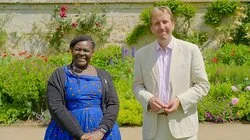
Martin Rees is perhaps Britain's most renowned cosmologist. He was master of Trinity College, Cambridge, President of the Royal Astronomical Society, the Institute of Physics, and has led the nation's foremost science institution, the Royal Society. Now, about to celebrate his 80th birthday, Lord Rees talks to Chris Lintott about his career in science.Lord Rees says he wasn't particularly interested in the night sky as a child, and only pursued science at school because he found languages difficult. He also regretted reading Maths at Cambridge, only finding his stride during his post-graduate studies when he was taken on by Dennis Sciama to undertake research in astrophysics, leading to his PhD.Rees's career spans what he calls a ‘golden age' for astronomy. Starting during a time when the origin of the universe was debated, with the flamboyant Fred Hoyle's ‘steady state' theory eventually put to the sword by the bookish Martin Ryle using the new technology of radio astronomy – in part aided and abetted by a young Martin Rees, whose work on quasars helped deal the fatal blow.Rees was a contemporary of Stephen Hawking, and witnessed first hand the excitement of seeing black holes elevated from speculative concept to integral part of our universe's evolution. Like many advances, including radio astronomy, this was an advance thanks to accidents in simultaneous progress. For radio astronomy, work on radar during WWII led to advances in seeing the universe in non-visible wavelengths. Though they had been postulated in the 19th century, the reality of black holes arrived via Einstein's theory of relativity, combined with radio astronomy and Roger Penrose's genius for maths.Time and again, over Rees's career, seemingly bizarre ideas in cosmology have turned out to have merit. Rees himself (and colleagues) showed that ‘dark matter' – a speculative ‘fix' for inconsistencies in galaxy dynamics – is also essential to the understanding of how the early universe found form, giving the concept increased credibility.One of science's most celebrated thinkers and writers, Rees has never been shy of engaging with difficult concepts. While the ‘big bang' solved the question of our origin story, it also raises other questions such as ‘what was there before the big bang?', and Rees enjoys considering the possibility that there are other universes, perhaps with the properties of our universe that gave rise to us, or perhaps wholly or partially different.Lord Rees also discusses the search for extraterrestrial intelligence, noting that while complex life may arise or has arisen in the universe, the likelihood is that, given the massive timescales involved, we are almost guaranteed to co-exist. But this leads to the intriguing prospect that any intelligent civilisation, including our own, is likely to create artificial intelligences that will supersede us, and may well be near-immortal.While Lord Rees worries about the threats that AI and mis-use of technology poses to our civilisation, he sees a potentially bright future in terms of scientific discovery, citing international collaborations and technological advances that might see us answering some of the questions we consider today to be too difficult. Like the start of the universe and black holes used to be not so long ago.
 E5
E5
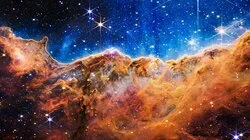
The British weather is often the enemy of stargazers up and down the country. A forecast of a couple of hours of cloud cover will disappoint even the most determined of amateur astronomers. So, this month, the Sky at Night becomes the ‘Sky at Day' to provide an alternative range of spectacles to observe and activities to partake in, ideal when the nights are short, and the stars are hiding behind the clouds.The most obvious spectacle to observe is of course our own star, the sun. A moment is needed to appreciate that whilst amateurs and scientists alike spend lifetimes and whole careers searching after distant stars in the night sky, we have a star on our celestial doorstep that we can actually send a space probe to. In 2018, that is exactly what Nasa did. The idea for the Parker Solar Probe was conceived in 1958, but it took 60 years to develop the technology to make it possible, namely, working out how to prevent it from melting.Justin Kasper, principal investigator for the Sweap instrument (Solar Wind Electrons Alphas and Protons investigation), spoke to Chris about how the probe entered the sun's atmosphere and made incredible discoveries about its structure. It revealed that the boundary where solar material anchored to the sun first escapes and becomes the solar wind is not a smooth ball but has spikes and valleys that wrinkle the ‘Alfvén critical surface'. Previously, the coronal streamers that cause this wrinkling had been observed from a distance but never measured directly until Sweap came along. Its discoveries are altering what scientists know about the way in which the sun's atmosphere transforms into the solar wind.Back on earth, Dr Hannah Wakeford shows us how observing the sun as it rises and sets in the sky can tell us a huge amount about the composition of our atmosphere and the weather on the horizon. The adage ‘Red sky at night, shepherd's delight. Red sky in the morning, shepherd's warning' is dismissed as many as an old wives' tale. However, due to our unique position in the mid-latitudes, it turns out that this saying may be more accurate than many think. Hannah also explores, as light travels from the sun to our eye, how different wavelengths are absorbed and scattered by the atmosphere, and the light that completes the journey to our eye or our telescope can reveal the combination of gases that make up the atmosphere. Hannah explains how this process has helped scientists to work out the composition of the atmosphere of other planets in our solar system and even exoplanets orbiting distant stars.Exploring during the day can sometimes unlock a whole new scientific field. Guest presenter George Dransfield spoke to urban micrometeorite hunter Jon Larsen about how he accidentally discovered a micrometeorite on his garden table whilst eating strawberries on a fine summer's day, and how, ever since, he has been pioneering a method for amateurs across the globe to discover pieces of stardust in their own back garden. George tries to find some micrometeorites of her own, and in the process, learns about the huge spectrum of micrometeorites that Jon, along with his partner Jan Braly Kihle, has found and photographed in astounding detail.As well as hunting meteorites and watching the sunset, there is also stargazing to be done during the day. Amateur astronomer and outreach hero Simon Holbeche from Bath spends every sunny weekend showing members of the public the sun in a whole new light. Using different specialist telescopes and heavy solar filters, Simon is able to show passers-by the incredible sunspots on the solar surface and the exploding prominences in the sun's atmosphere. His enduring hope is that those passers-by might become hooked by what they've seen, and one day come back to see the sky at night.
 E6
E6
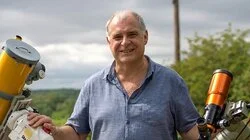
On 12 July 2022 the Sky at Night joined the rest of the world to watch as the James Webb Space Telescope released its long-awaited first images. And it didn't disappoint. Stars and galaxies were revealed in such detail that they blew even the most experienced astronomers away. However, as spectacular as these images were, it was the data that they represented that really excited the scientists watching.Chris Lintott travels around the country, meeting some of the scientists getting their hands on the very first batches of data coming from the JWST. His first stop is Professor Andy Bunker at the University of Oxford, who is pushing the world's newest space telescope to its limits to look for some of the first stars and galaxies formed after the big bang.Chris also meets Dr Mika Matsuura of Cardiff University. She is studying the gas structures that dying stars exude as they reach the end of their lives. Mika explains how the incredible infrared capabilities of the JWST allow her to probe the discs of dust and gas around nebula and reveal the surprising conditions that form them.Chris then heads on to the University of Bristol to visit Dr Hannah Wakeford, who is incredibly excited by her data, data that is revealing the secrets of the atmospheres of exoplanets orbiting far-flung stars. Hannah's method of studying exoplanets uses the JWST to measure the light from a target star as an exoplanet ‘transits' in front of it, briefly and almost imperceptibly dimming it. It is these incredibly precise measurements, only made possible by the sensitivity of this new supertelescope, that she hopes will change what we know about the atmospheric composition of these distant worlds.Finally, Chris visits Professor Leigh Fletcher at the University of Leicester. Leigh is using the space telescope to look a little closer to home and shows Chris the latest images of Jupiter revealed in a whole new light by the JWST's infrared data. He explains to Chris the difficulties of capturing large bright objects in the telescope's small field of view, and what his plans are for studying our solar system's gas giants.Meanwhile, Maggie Aderin-Pocock gives a JWST masterclass in the studio. Why is this telescope so revolutionary and how exactly does it work? She looks at why the JWST is observing light from the infrared part of the electromagnetic spectrum, and also why scientists chose to place the telescope in a location so far from Earth that we could not fix it if something went wrong. Maggie also explores the instruments that call the telescope home and takes a closer look at some of the tricks they have up their sleeves.
 E7
E7
For centuries, humans have been drawing what they see in the night sky through telescopes. But there is something about a photograph that can make you feel like you are right there, up close to the moon, planet, star or galaxy you are looking at. Having the light from those distance objects, fixed in an image, has meant scientists can analyse and understand the beautiful universe around us. So, this month, the Sky at Night is looking at the wonderful world of astrophotography.Dr Jen Gupta visits Chris to talk about her favourite pictures, many of which have changed our very understanding of the cosmos. Some leave us with questions still to be answered even 60 years on.Maggie is in Scotland looking at the latest in new technology being built for the Very Large Telescope. Once installed, it will give scientists the ability to understand and study the formation of galaxies throughout the entire history of the universe.Meanwhile, the Sky at Night's very own astrophotographer, Pete Lawrence, is being taken on a trip down memory lane at some of his highlights over the years.Plus, a look at how the camera on your phone can be a great place to start if you are new to taking astrophotographs and want to give it a go.With favourite pictures, competition-winning images and a guide to all there is to see and do in the coming month, there is lots to discover.
 E8
E8
A special ‘Question Time' edition of the programme, recorded at The Venue in De Montford University, Leicester, as part of the British Science Association's annual science festival.Chris, Maggie and Pete are joined on stage by planetary scientist Dr Suzie Imber and astronomer Professor Nial Tanvir to answer questions from viewers, covering all things astronomical – from the size of the universe to the possible nature of alien life.Chaired by Dallas Campbell.
 E9
E9
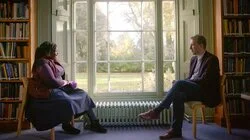
The Sky at Night in the Multiverse of Mystery is a magical journey into the far-flung ideas at the very edge of scientific knowledge, exploring the concepts that today seem like science fiction but may one day become science fact.Delving into the archive at the Royal Society, we look at the dreamers who first considered the possibility of travelling to the moon and black holes long before they could be proven to exist. From there, the team explore some ideas and theories that today could be dismissed as fanciful thinking.They imagine a world where a popular TV programme asks two scientists, Hiranya Peiris and Emma Chapman, to meet, have dinner and talk science, all under the watchful eye of maître d' Pete Lawrence.Meanwhile, Maggie Aderin-Pocock sails off to explore the realities of interstellar travel and astrobiologist Doug Vakoch explains some of the challenges of communicating with aliens. Astrophysicist Becky Smethurst is lost in a world of black and white holes, and Chris Lintott, as you have never seen him before, argues the case for a multiverse.Along with animation from the BBC Ideas team, this edition of The Sky at Night shines a very different light on the world of astrophysics.
 E1
E1
Maggie Aderin-Pocock and Chris Lintott look back at some of the biggest stories featured on the programme in 2020, with the help of special guests who have chosen their favourite moments.From the launch of Solar Orbiter to the discovery of phosphine on Venus, the team relive the astronomy highlights of a highly unusual year.
 E2
E2
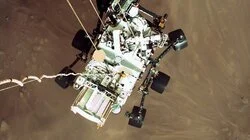
In February, orbiters from China and the UAE settled into their positions above Mars, and Nasa's Perseverance rover touched down on its surface. Maggie Aderin-Pocock reviews the astonishing footage the rover has already sent back, and talks with its legendary chief designer Adam Seltzer about the challenges of missions to the red planet.Chris Lintott reveals the incredible ‘track-and-trace' story behind the discovery of the Winchcombe Meteorite, and is given special access to the labs at the Natural History Museum to see the meteorite itself. Chris meets Dr Ashley King, who is co-ordinating UK-wide research into the rocky interloper, which it is hoped might tell us more about the early universe and reveal clues to the origin of life.Pete Lawrence is on hand with a guide to viewing planets in the night sky, and to tell us what to look out for over the course of the rest of the year, and Maggie pays tribute to her childhood hero, Soviet cosmonaut Yuri Gagarin, who became the first person in space 60 years ago this month.
 E3
E3
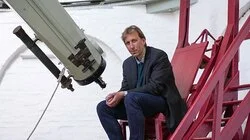
The Gaia space telescope is not just create the ultimate star map of the Milky Way. It is also showing us our galaxy's past and how it will change in the future.The Sky at Night team takes a look at the history of astrometry and meets the scientists now able to prove that change is the only constant in the universe.
 E4
E4
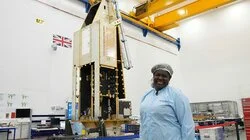
The Sky at Night team visit the companies spearheading the boom in Britain's space industry, a sector with an annual income of £16.4bn and which employs over 45,000 people.
 E5
E5
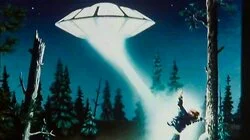
Chris and Maggie dive into the archives to discover how the hunt for extra-terrestrial life in the universe has been reported by the BBC over six decades. Such luminaries as Patrick Moore, Arthur C. Clarke, Carl Sagan, James Burke and Alan Whicker discuss the eternal question of whether we are alone. The story of how the BBC has covered advancements in this scientific field is told from the birth of radio astronomy in the 1960s to the discovery of the first planets outside of our own solar system in the 1990s, and right up to probes exploring our neighbouring planets in the present day. There are also some rather more offbeat claims of UFO sightings, alien abductions and accounts of humanoid-like beings that supposedly live on Venus.
 E6
E6
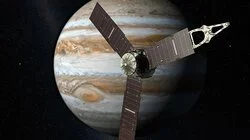
August 2021 marks ten years since Nasa's mission to Jupiter, Juno, was launched. The mission – to uncover the mysteries surrounding Jupiter's formation – was expected to end this year with the $1.1 billion satellite deorbiting into the planet's gassy atmosphere. But thanks to the ingenuity of its engineering, the robust spacecraft has surpassed expectations and been granted an extension to its life.The Sky at Night looks at the amazing research that has resulted from this mission, expanding our understanding of the gas giant and explaining how Juno will now use its extra time in orbit to gather information for future Jupiter-bound missions – Nasa's Europa Clipper and the European Space Agency's Juice mission.
 E7
E7
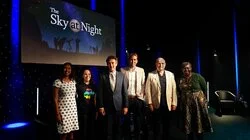
A special ‘Question Time' edition of the programme, recorded at the Civic Theatre, Chelmsford, as part of the British Science Association's annual science festival.Planetary scientist Dr Carly Howett and cosmologist Professor Hiranya Peiris join Chris Lintott, Maggie Aderin-Pocock and Pete Lawrence to answer questions from viewers covering all things astronomical – from the size of the universe to the possible nature of alien life.Chaired by Dallas Campbell.
 E8
E8
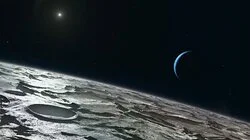
Of the 100 probes that have been sent out into space, only one probe - Voyager 2 in 1989 - has ever sent back any information about the solar system's outer planets. From afar, they seem featureless and devoid of any significant geological activity.Since then, long-range telescopes have shown that there is much more to Neptune and Uranus than previously thought and that they both warrant closer inspection. Time, however, is of the essence. Deep-space missions are dependent on Jupiter. The slingshot effect it provides to move probes along the way is only available to us every 25 years.
 E9
E9
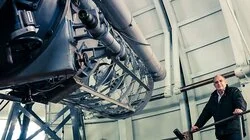
The Sky at Night team explore the history of the telescope – from Harriot and Galileo's lunar observations to the Hubble and James Webb space telescopes – revealing how developments in the power of lenses have increased our understanding of our place in the cosmos.
 E10
E10
Chris and Maggie look back at some of the stories they have covered in 2021 in the Sky at Night's big review of the year.
 E1
E1
The Sky at Night team go back to basics to show you how to enjoy the night sky, wherever you are. It doesn't matter if you live in a city or in the countryside, if you have a telescope, a pair of binoculars or just your eyes to look with.Pete explains why the night sky changes and joins a group of novice stargazers to talk about the best ways to introduce newcomers to the night. Chris ventures onto a roof in Oxford and marvels at the moon through binoculars, and Maggie goes back to her childhood telescope-making class to talk basic telescope essentials.Curious about the night sky but don't know where to start? Want to know how to make the most of your new telescope? This is the programme for you!
 E2
E2
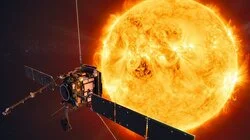
Esa's solar orbiter was launched from Cape Canaveral earlier this year on a decade long mission to discover the secrets of our sun. And the Sky at Night was there to capture all the action. Two aspects of this mission make it unique. First, the spacecraft is designed to capture the highest resolution images of the sun ever taken. And then it will orbit the sun to give us a glimpse of what's happening at the its poles, areas we have never seen before.In this programme, we discover just how this spacecraft was built, how it will protect itself against the sun's searing heat and how it will investigate the mysteries of the sun with a suite of ten instruments designed and built across 17 European countries.
 E3
E3
The Sky at Night celebrates its 800th episode while filming takes place under the coronavirus lockdown.Chris Lintott explores how some astronomers are managing to continue making observations by controlling telescopes as far away as Hawaii from a laptop in their bedrooms in Belfast. Maggie Aderin-Pocock investigates how members of the public can get involved in analysing data from Mars, even when they are confined to their homes. And Pete Lawrence points out some treats in the night sky that we can all see if we keep looking up even when we're locked down.Plus a treat from the archives of the last 799 episodes set to a specially commissioned new arrangement of the show's famous theme tune.
 E4
E4
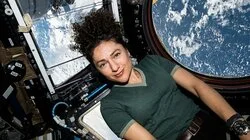
The Sky at Night team explore a changing world. Maggie Aderin-Pocock interviews astronaut Jessica Meir, who returned from 205 days on the International Space Station to a world she barely recognised. They also discuss Jessica's experiments in micro-gravity, growing lettuce in space and the first all-female spacewalk.Chris Lintott meets the astronomer who recently announced the discovery of the closest black hole to Earth. Pete Lawrence photographs the dark side of Venus and Lucie Green investigates whether Elon Musk's constellation of Starlink satellites are ruining the night sky.
 E5
E5
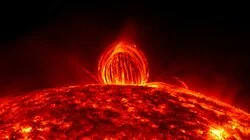
The Sky at Night team explore the life and death of stars. Chris Lintott investigates the strange dimming of Betelgeuse, which caused some speculation that it might be about to explode into a supernova. And Maggie Aderin-Pocock reports on the recent discovery of the biggest and brightest supernova ever observed.Lucie Green discovers how historical drawings that pre-date the invention of the telescope are helping us to predict solar activity, and Pete attempts to photograph our very own star, the Sun.The team also pay tribute to pioneering astronomer Margaret Burbidge, who died on 5 April 2020 at the age of 100, whose work led to the understanding that we are all made of stardust.
 E6
E6
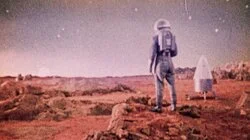
Mars has fascinated us ever since we first looked up to the heavens. We have imagined alien civilisations, exotic life forms and even dreamed of travelling there ourselves. But after the first probes flew past the Red Planet, and with each subsequent mission that has orbited or landed on its surface, that vision has changed. We have come to realise that the planet is, most likely, dead. But that hasn't dimmed our hopes for finding evidence of past life. And our desire to travel there and colonise the Red Planet still endures.From the very beginning of this exploration, the BBC has recorded our shifting perception of Mars. Since the Sky at Night started broadcasting in 1957, there have been over 50 episodes devoted to Mars and more than ten episodes of Horizon. This programme looks back at that coverage.
 E7
E7
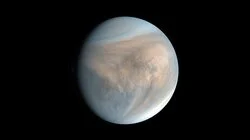
The Sky at Night gains exclusive access to the team of scientists behind the recent discovery of possible signs of life on Venus. Recorded in secret before the news broke, the film reveals the story behind this extraordinary piece of scientific discovery.
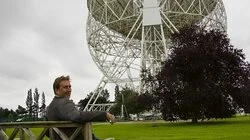 E8
E8
How vision-impaired astronomers are able to see the universe.
 E9
E9
Chris and Maggie report on the reaction to the dramatic announcement of the discovery of phosphine gas in the clouds of Venus, a gas that could be a sign of life.
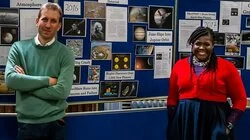 E10
E10
Chris Lintott and Maggie Aderin-Pocock consider the state of astronomy in 2020 and wonder what new, exciting discoveries await across the rest of the decade.
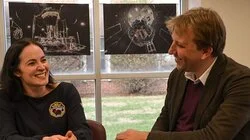 E1
E1
On 1 January 2019, Nasa's New Horizons probe notched up another historic first: the first ever Kuiper belt fly-by. Its target was 2014 MU69, a chunk of ice and rock about four billion miles (approximately 6.4 billion kilometres) from Earth, dubbed Ultima Thule, a Latin phrase meaning a distant, unknown region. It is the most distant fly-by in history, and it is believed the data New Horizons gathers will shed new light on the solar system's early days. Chris Lintott reports from the John Hopkins Applied Physics Laboratory in Maryland to bring the latest news and pictures from this extraordinary mission.
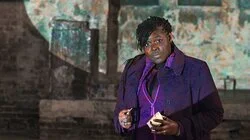 E2
E2
Ever since we discovered that distant galaxies are racing away from us, there has been a heated debate over just how fast the Universe is expanding.At the beginning of the 21st century, we thought we knew the answer. But now, two very different viewpoints have emerged. And they are dividing the scientific community.The Sky at Night meets leading astronomers and cosmologists on both sides of the debate. Which team has the right answer? Or could bothteams be right? If so, we may need to rethink everything we think we know about the Universe.
 E3
E3
Marsquake! This month's episode follows Insight, NASA's latest mission to the Red Planet, as it goes in search of the secrets buried deep below Mars's surface. By listening for tremors caused by Marsquakes and meteor strikes, scientists hope to reveal how the planet was formed, why its fate was so different from the Earth and whether the planet is dead or alive.The programme also says a heartfelt goodbye to Opportunity, the rover that explored the surface of Mars for more than 14 years until it was engulfed by a dust storm last year.
 E4
E4
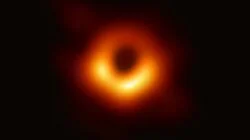
This month, the Sky at Night team reveals how the first picture of a supermassive black hole was captured. When the photograph of the hole at the heart of the M87 galaxy was released in April, it captured the world's imagination and made headlines everywhere.Chris Lintott reports from behind the scenes, meeting the scientists from the Event Horizon Telescope who worked for a decade to capture the image. And Maggie Aderin-Pocock reveals the mysterious and terrifying power of this astonishing cosmic phenomenon.
 E5
E5
In the first of two programmes to commemorate the 50th anniversary of the Apollo Moon landings, the Sky at Night team take a look at the latest plans to return to the Moon. Recently, China, Israel and India have all sent major missions to the Moon. The Europeans and Americans are planning to build a space station in permanent orbit around the Moon. And NASA has just announced that they plan to land astronauts on the Moon's surface within five years. It all suggests that we are on the verge of a new golden age in lunar exploration.
 E6
E6
To celebrate the 50th anniversary of the Apollo mission to put a man on the moon, The Sky at Night looks back through the archives to tell the story of how the BBC reported the moonshot, with some very special guests. Scientist John Zarneki discusses the huge scientific and engineering challenge. The first British astronaut, Helen Sharman, reveals just how accurate the predictions and preparations for life in space were. And writer and broadcaster James Burke - who reported the whole amazing story at the time - explains why Nasa loved the BBC and how he gained access to the command module for an episode of Tomorrow's World.
 E7
E7
Only a handful of missions are sent into space every decade, but how do we decide which missions are cleared for launch and which are grounded?This month the Sky at Night goes behind the scenes as the European Space Agency select their next F-class mission, scheduled to be launched in 2028. And we meet the British teams vying to have their ideas selected, including a revolutionary mission to a comet.
 E8
E8
It is not just our sun that is circled by planets. In recent years, astronomers have found over 4,000 planets circling stars other than our own. The Sky at Night team investigates what we know about these alien worlds and looks at how we have managed to detect them.Professor Chris Lintott visits the UK Astronomy Technology Centre in Edinburgh to see a cutting-edge camera designed to take pictures of exoplanets. And Dr Maggie Aderin-Pocock talks to experts about the continuing hunt for alien worlds and, even, alien moons.Meanwhile, Pete Lawrence sticks to hunting for planets in our own backyard, looking for Neptune and explaining what is meant when a planet is said to be in opposition.
 E9
E9
A one-hour special in which The Sky at Night team face a live studio audience to answer their questions about the mysteries and wonders of the universe.
 E10
E10
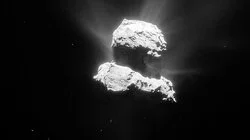
The Rosetta mission to comet 67P was the first time a spacecraft landed on a comet's surface. What has this icy body taught us about the dawn of the solar system and the origins of life on earth?
 E11
E11
Looking back on the major stories of the year - from the New Horizons mission to the most distant world we have ever visited to the release of the first-ever picture of a black hole. The team relive the highlights and uncover the latest developments.
 E1
E1
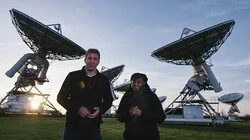
The Sky at Night reports on one of the most unnerving discoveries in space science - that most of the universe is missing. We live in a material world, so instinctively we know what normal matter is - the world around us, the planets, stars and interstellar dust. But scientists currently estimate that 95 per cent of everything in the universe is actually - one way or another - invisible. Some of this is ordinary matter that we just can't easily see. But there's also stuff that's much more weird. For instance, there's a new kind of matter we think is out there, but whose very existence is still largely hypothetical - dark matter. And most mysteriously of all, scientists think there is an unknown form of energy pervading the universe that we know so little about, all it has so far is a name - dark energy. The Sky at Night takes you on a tour of this invisible universe, and shows how its existence - or lack of it - will define the fate of the entire universe.
 E2
E2
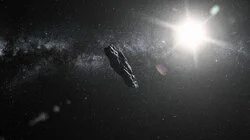
The team investigates an astronomical detective story. In October 2017, astronomers spotted the first ever object to visit our solar system from outer space. They called it 'Oumuamua. Its discovery set off a hurricane of press speculation and a major scientific investigation. The Sky at Night goes to Queen's University in Belfast, which has become the centre of scientific research on this cosmic visitor. When they first spotted it, all scientists knew was that it was small, it was travelling fast, and it came from outside our solar system. What did it look like? How had it formed? What was it made of? Where had it come from? To answer these questions, the team pieces together all the clues that scientists have extracted from the small amounts of data collected as 'Oumuamua flashed through the solar system.
 E3
E3
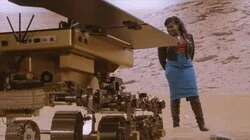
Maggie Aderin-Pocock and Chris Lintott reveal the latest results from Nasa's Curiosity and Esa's ExoMars TGO missions that are attempting to find signs of life on Mars. Maggie visits the Airbus 'Mars Yard' to find out how the next lander heading to Mars is being built to survive the planet's incredibly hostile environment. And the team asks - if Mars is a dead planet, could the first life on Mars be humans? Chris talks to Andy Weir, author of The Martian, about whether a manned mission to Mars is just a fantasy.
 E4
E4
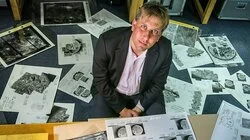
For past three and a half years, ESA's Gaia Space telescope has been mapping the heavens in unprecedented detail. At the end of April 2018 it released precise data on over 1.3 billion stars in the Milky Way showing how they move over time and their distance from Earth. Maggie and Chris reveal some of the most surprising initial findings, from the discovery of wandering black holes, hyper velocity stars and 'transient phenomena' to a brand new age map of the Milky Way and concrete evidence of how our galaxy formed.
 E5
E5
Nasa's Juno spacecraft is currently making its 13th orbit of Jupiter on one of the most ambitious and risky space missions ever undertaken. The astonishing images it has captured are not just visually stunning, they also deliver spectacular scientific insight, revolutionising our ideas about Jupiter. Maggie Aderin-Pocock explores these stunning discoveries, from a new understanding of Jupiter's core and formation to revelations about how deep its raging storms penetrate the planet's mysterious interior.
 E6
E6
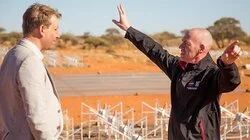
In February 2018, news broke that astronomers had seen the cosmic dawn - the moment when stars first formed, flooding the universe with light. What's remarkable is that this incredible event was discovered by an instrument the size of a ping-pong table in a remote corner of Western Australia. Chris Lintott travels to the Murchison Radio-astronomy Observatory to find out how they did it and what else the extraordinary radio telescopes there can tell us about the universe.
 E7
E7
This episode looks at a solar phenomenon called coronal mass ejection - violent eruptions from the sun's surface - examining just how damaging a CME could be and how astronomers, using two new satellites that will travel closer to the sun than ever before, can better prepare us for its impact. A well-known example of a CME was recorded in 1859, when a spectacular blood-red aurora borealis appeared across America. Earlier that same day, in a leafy garden in the UK, a gentleman astronomer had noted a 'white light flare' on the sun's surface. The two events were linked, and it is now known that the flare caused the aurora. Back then, it was considered an astronomical curiosity, but when it happens again, it will be a different story. For the modern, technological world such a violent solar phenomenon could be devastating.
 E8
E8
A look at two missions attempting one of the most difficult feats of space exploration, to collect a rock from another world. This episode checks in on the US and Japanese attempts to bring a piece of an asteroid back to Earth. The missions have taken decades of planning, but the results will be worth it. We'll find out how studying these space rocks can teach us about the origins of our solar and may one day help save earth from a catastrophic collision.
 E9
E9
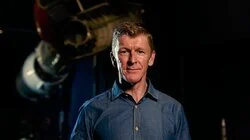
This edition looks at Britain's attempt to become a major player in the modern space race. From Scotland's wild northern shore, where Britain's first spaceport is planned, to the team planning Britain's new rocket system, the programme explores the technology behind a quiet revolution in Britain's space industry. Driving the resurgence of 'space Britannia' is a new breed of spacecraft - micro-satellites. As many as 12,000 of them will be built and launched worldwide over the next decade, and Britain is aiming for a slice of the action. Also, guest presenter Tim Peake celebrates Britain's past achievements in space and finds out where it all went wrong.
 E10
E10
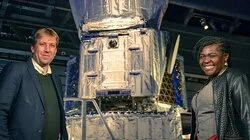
Documentary series. Mercury, unique amongst the planets, is shrinking. And that's only the beginning of how strange the solar system's smallest planet is. In October 2018 a new mission to Mercury was launched - BepiColombo. It's a spacecraft consisting of two separate orbiters. Together, these hope to achieve the most complete exploration of Mercury to date.Since its launch, the spacecraft has been hurtling through space towards the inner solar system on an arduous seven-year journey that includes nine fly-bys of other planets. Its destination is dangerous: Mercury has some of the most extreme conditions in the Solar System.The Sky at Night investigates how Bepi was built, how it will get to Mercury and what it hopes to discover. Three big questions are at stake. How did Mercury form? Why is it shrinking? And how has it survived the full blast of the sun?
 E11
E11
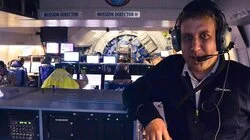
In this special programme, the Sky at Night takes to the air on board the largest airborne observatory in the world - a specially modified jumbo jet, flying out of California. This extraordinary aircraft is home to a 17-tonne telescope that observes the galaxy from around 40,000 feet. This telescope - called SOFIA - specialises in infrared astronomy. It can peer into the heart of a galaxy through the dust and gas, and see how stars form. It's designed to answer some of the biggest questions in astronomy: why aren't more stars being created and how do planets form?
 E1
E1
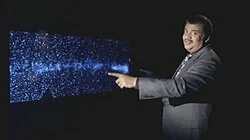
All good travel guides need a map, and the team unveil the most detailed 3-D map of the Milky Way ever produced. A map that reveals that there may be 50 per cent more stars in the galaxy than we previously thought. American astronomer Neil deGrasse Tyson gives us a guided tour of the strangest stars we have ever observed, and we discover that the Milky Way may already be colliding with our neighbouring galaxy, Andromeda.
 E2
E2
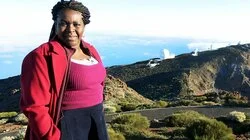
The team travel to the island of La Palma in the Canary Islands where they take control of some of the world's largest telescopes to view the most spectacular sights in the night sky.
 E3
E3
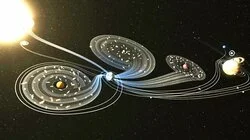
When the first episode of The Sky at Night was transmitted in April 1957, it was still thought that Mars could be home to advanced life, the Space Age was yet to begin, and the Big Bang was just a controversial theory. So to celebrate its 60th anniversary, this special programme looks at how our knowledge of the universe has been transformed in the last six decades - from the exploration of the solar system to the detection of black holes and planets orbiting distant stars. Featuring contributions from Jim Al-Khalili, Dallas Campbell and Monica Grady and including special birthday messages from a host of stars, this is a celebration of an extraordinary age of discovery, and The Sky at Night's role in covering it.
 E4
E4
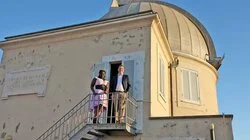
This edition comes from the heart of one of the most influential - and surprising - organisations in the history of astronomy. Maggie and Chris have been granted rare access to the Vatican and its little-known observatory, the Specola Vaticana, perched on a hilltop 30km outside Rome.There they explore its rich history and contemporary cutting-edge science, going inside the Vatican walls to visit the Tower of the Winds, a secret antique sundial that revolutionised the length of the year; the remains of a nest of telescopes atop an old medieval church where the science of spectroscopy was born; and the modern labs, manned by priest scientists who study a range of contemporary astronomical problems, from meteorites to binary stars to the birth of the universe itself.
 E5
E5
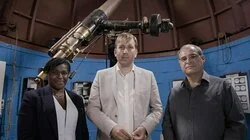
Scientists have spent hundreds of years observing the planets with telescopes and over fifty exploring the solar system through space travel, so you might have thought they knew our cosmic neighbourhood pretty well.But actually, they've hardly scratched the surface. The reality is that most of the solar system is still almost a complete mystery. Beyond the orbit of Neptune lies a vast number of strange, dark, icy worlds - the trans-Neptunian objects. And it's only over the last few years that we've even started to see and understand them, and have begun to realise they play a crucial role in the evolution of our solar system.Maggie Aderin-Pocock and Chris Lintott discover how we've found hundreds of thousands of these strange new objects, some with multiple moons, others with strange orbits, and some spinning way faster than any planet in the solar system.Marcus du Sautoy explores how studying the mathematics governing the behaviours of these objects has changed our understanding of how the solar system evolved, and how it might eventually end.
 E6
E6
In August, the most spectacular meteor shower of 2017 coincides with transmission: The Perseids! If it's clear, it'll be a great chance to see scores of bright shooting stars streaking across the night sky. As those shooting stars vaporise in the atmosphere, a small part of some of them will fall to earth as dust.This dust will contribute to a total of about 40,000 tonnes of space dust and debris that falls onto our planet every year. In this episode, Chris Lintott and Maggie Aderin-Pocock investigate this mysterious cosmic debris that comes from outer space.
 E7
E7
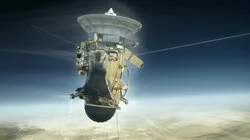
On 15 September 2017, the most successful space mission of all time will come to a dramatic and violent end as the Cassini probe is sent crashing into the planet Saturn. This one space probe has rewritten the rules of space exploration, repeatedly surprising scientists with its incredible and unexpected observations. It discovered lakes of pure methane on Saturn's moon Titan, mysterious weather systems on Saturn itself, and all the conditions for life on the moon Enceladus. It has exceeded every expectation of its original design brief, and its mission duration has been extended not once but four times. Its legacy for science and for space travel is unique. Chris Lintott and Maggie Aderin-Pocock explore four major ways in which space exploration of the future has been changed by the discoveries of the Cassini mission.
 E8
E8
Nearly 50 years ago, Neil Armstrong stepped onto the moon and it seemed like the dawn of a new age. Soon we'd be flying to the moon as effortlessly as we fly to America, and a moon base would be filled with men and women building a better future out in space. But then the moon fell out of fashion. We soon realized it was brutally inhospitable and getting there was eye-wateringly expensive. Rather than spend huge sums of money going where we'd already been, Mars and the other planets seemed much more exciting destinations. But now that is set to change. For the first time in a generation, there are credible plans to go back to the moon, and maybe even build a working moon base. The Sky at Night examines this renewed interest in the moon, and asks why it's happening now and who is at the forefront of this new wave of lunar exploration. They meet the tech companies driven by big ambitions to launch a new era of space exploration using private money. So, is a moon base really viable, or merely a pipe dream?
 E9
E9
This month The Sky at Night explores this world of transient phenomena. We hear more about the explosive event that created the recently detected gravitational wave - the collision of two neutron stars. And Chris spends 24 hours at the SWIFT space telescope base in Leicester in an attempt to detect a gamma ray burst - the most powerful and extreme short-term event known.Maggie goes to meet the team that are searching for the mysterious, barely understood transient phenomena called fast radio bursts. And Lucie Green reveals that some important short-term phenomena can occur much closer to home too.Astronomy used to be about staring up at the unchanging sky, so this search for transitory objects is truly revolutionary. It's time to enter the spectacular world of astronomy that takes place... in the blink of an eye...
 E10
E10
The Sky at Night celebrates one of the most profound, moving and enjoyable activities there is - the ancient art of looking up, studying and marvelling at the night sky. The programme is based at the Royal Observatory, Greenwich - the spiritual home of British astronomy - and sets out to discover the many and varied ways we can all enjoy the majesty of the skies. Maggie Aderin-Pocock travels to Norway to see the northern lights, and discovers that we are in a golden age of aurora research as she learns what they tell us about the solar system. Chris Lintott learns the ancient art of navigating by the stars, whilst Pete Lawrence helps choose the right equipment to set yourself up as an amateur astronomer.
 E1
E1
On January 20 2016, two American astronomers made an extraordinary claim - they had found evidence for a ninth planet in our solar system, a planet 20 times further out than Neptune which would take up to 20,000 years to orbit the sun. It is a discovery that could completely rewrite our understanding of our solar system and how it formed.As the world's biggest telescopes start scanning the skies searching for Planet 9, the Sky at Night team investigates. If Planet 9 exists, where is it and where did it come from?In California, Chris Lintott meets the astronomers whose study of the distant Kuiper Belt led them to predict the existence of the planet. And while some scientists are still sceptical, Maggie Aderin-Pocock discovers how our models of the formation of the solar system and the discovery of similar exoplanets around other stars all support the existence of Planet 9.
 E2
E2
For 50 years we have been sending probes to gather close-up images of the other planets and moons of the solar system. The Sky at Night presents the five greatest images captured by those spacecraft. From a view of the surface of Mars, to live pictures of the sun and a unique picture of our own planet, these are the images that have transformed our perception of the solar system we live in.
 E3
E3
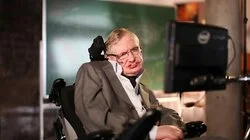
The programme looks at the latest understanding of black holes, featuring an interview with Stephen Hawking. Black holes are one of the greatest mysteries in the universe. They behave in a way that is contrary to laws of physics and one has never actually been seen. However, the recent detection of gravitational waves, as predicted by Einstein, proves that black holes exist and provides a way to investigate their remarkable behaviour and properties.
 E4
E4
May 9th 2016 sees one of the astronomical highlights of the year - a transit of Mercury across the sun, the best opportunity to observe this phenomenon until 2049. To mark the event, the Sky at Night attempts to explain the many mysteries of Mercury - a planet so bizarre that it is sometimes described as the 'problem child' of the solar system. Surface temperatures exceed 450 degrees but it also has patches of ice, its day is twice as long as its year, and it is a planet that appears to be shrinking.
 E5
E5
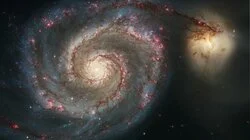
The Sky at Night focuses its attention on M51 aka the Whirlpool Galaxy. Sitting approximately 30 million light years from Earth, this spiral galaxy was discovered in 1773 by the French astronomer Charles Messier. It is thought to have been the inspiration behind the swirling patterns of van Gogh's Starry Night. June 1st has been declared Whirlpool Galaxy Day. On this one day we will be aiming as many telescopes as possible at the galaxy. Images will be taken by optical and infra-red telescopes on top of volcanoes in Hawaii and La Palma, the radio signature will be captured at the Mullard Radio Astronomy Observatory in Cambridge, and in orbit the Swift space telescope will aim its ultraviolet and X-ray sensors at the galaxy. By examining the galaxy at as many magnifications and wavelengths as possible the programme will build up a portrait of this galaxy - unlocking the secrets of the formation of the spiral arms and revealing how they have triggered a wave of intense star formation.
 E6
E6
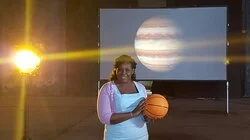
A look behind the scenes of Nasa's project to study Jupiter. As the spacecraft Juno enters Jupiter's orbit, the programme explores the dangers of the mission and what Nasa is hoping to discover about the giant planet - from the secrets of its formation to the source of the solar system's most powerful aurora.
 E7
E7
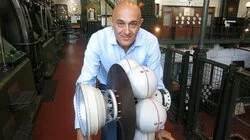
Following the recent discovery of an Earth-like planet orbiting Proxima Centauri, the Sky at Night focuses on our nearest neighbouring star. As well as telling the story of the of the discovery of the new planet and revealing what conditions may be like on its surface, the team is also joined by Professor Jim al-Khalili to investigate the possibility of building a spaceship that could travel the 4.23 light years to Proxima Centauri.
 E8
E8
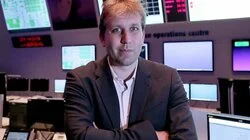
The Sky at Night goes behind the scenes at the European Space Agency as the Rosetta mission reaches its conclusion and the spacecraft is crashed into the surface of comet 67P Churyumov-Gerasimenko. For nearly two years the Rosetta spacecraft has been in orbit, studying the comet at close range and returning extraordinary pictures. But now the the mission must end and the project scientists have decided to have one final attempt at studying it at close range. On September 30th the spacecraft - with all its instruments running - will be crashed into the surface of the comet. Its aim is to get the best ever view of the mysterious pits on the comet's surface, pits whose walls are thought to have been undisturbed for over 4 billion years. Chris Lintott will be in mission control with the scientists as they watch the pictures come in from the spacecraft's dive towards the surface. Maggie Aderin-Pocock will be investigating how the mission has transformed our understanding of comets.
 E9
E9
The Sky at Night team investigates the ongoing hunt for life on Mars. It is one of the great scientific questions of our time, but are we any closer to finding an answer? As well as uncovering the cause of the recent crash of the Schiaparelli lander, the team looks at the next missions designed to hunt for life on the red planet - from a rover designed to drill deep into the surface, to the orbiter sniffing for signs of methane in the atmosphere. Adam Rutherford joins the team to ask if we have been deliberately avoiding the most likely places to find life on Mars.
 E10
E10
The Sky at Night team looks back on the major stories of the year and sees how they have developed since they hit the headlines. 2016 has been a remarkable year in many ways, but one area in which it has been particularly good is in space science. There have been new missions to Jupiter and Mars, planets have been found on the outskirts of the solar system and around our nearest neighbouring star, and the discovery of gravitational waves has potentially given us a new way of investigating the universe. What has the Juno probe discovered at Jupiter? Has Planet 9 been found? And are we any closer to finding Earth-like planets elsewhere in the galaxy?
 E1
E1
The Milky Way, our galaxy, is a magnificent sight in the night sky, but we know surprisingly little about it for certain. What is its shape? How many stars does it actually contain? What lies at its centre?The Gaia space telescope will answer these questions, being armed with the most advanced camera to leave our planet, and it will allow us to see our galaxy as we've never seen it before. The Sky at Night visits the factory in Chelmsford that made the astonishing sensor at the heart of the mission.
 E2
E2
From unexplained flashes in the night sky to flying saucers, this episode delves into the mysterious world of UFOs. How our drive to explain these bizarre phenomena, and desire to discover little green men, has in fact transformed our understanding of the universe.
 E3
E3
For 25 years the Hubble Space Telescope has been showing us the cosmos as we've never seen it before. The team reveals the 'top five' greatest images Hubble has produced, images that have astounded us, transforming our understanding of the universe and our place in it.
 E4
E4
How can two such similar planets have become so different? One is the crucible of life, the other an inferno with a surface scorched by raining acid, yet both began as almost identical bodies. With Venus prominent in the sky in May, the team explores our nearest neighbour, discovering how it formed and how ESA's Venus Express spacecraft has revealed the secrets of its atmosphere.
 E5
E5
With the exciting news that the Philae lander had woken up on comet 67P, Sky at Night reveals the latest results from the Rosetta comet landing. What have they learnt so far from Philae's onboard instruments? What do the stunning images from Rosetta tell us about the formation and structure of comets? And project scientist Matt Taylor shows how Rosetta is measuring the growing tail of the comet as it hurtles towards the sun.
 E6
E6
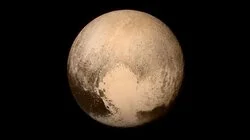
Maggie Aderin-Pocock and Chris Lintott present the inside story of NASA's groundbreaking visit to Pluto. This is the first time any probe has visited the dwarf planet and Sky at Night has ringside seats, bringing you the entire story and expert insight into the latest images from the New Horizons probe. Sky at Night celebrates its 750th episode with the most exciting space event of 2015.
 E7
E7
The Sky at Night team look at cosmic explosions. They explore the beautiful but potentially deadly outbursts of our very own star - the sun - and the most violent and energetic events in the universe, gamma ray bursts.
 E8
E8
The team looks at the dynamic nature of the universe, winding its timeline backwards and forwards to reveal how the night sky changes over time. We see how different the night sky looked in the past and how it will be transformed billions of years into the future as the stars migrate and galaxies collide. Broadcast from the Royal Observatory Greenwich, the team explores the latest theories on solar system evolution - how the familiar layout of today's solar system was created by a gravitational dance between the giant planets that left scars we can still see today.
 E9
E9
We think of volcanoes as some of the most powerful natural phenomena on earth - but they are nothing compared to the volcanoes we find elsewhere in the solar system. This month's Sky at Night reveals the weird and wonderful world of volcanism on other planets and moons - from the giant extinct volcanoes of Mars to the tantalising possibility of continuing eruptions on Venus, and from the vast sulphur plumes of Io to the mysterious cryovolcanoes of Enceladus.
 E10
E10
As we close in on the discovery of the 2,000th planet outside our solar system, or exoplanet, the Sky at Night investigates the techniques that are revealing so much about these alien worlds. The programme asks if we are really any closer to finding another world like our own - a second Earth.
 E11
E11
The Sky at Night team go in search of what could of caused the Star of Bethlehem. Explored are theories that include supernovae, comets, meteors and a unusual alignment of the giant planets.
 E1
E1
New presenter Dr Maggie Aderin-Pocock joins Dr Chris Lintott in a revamped line-up that launches the show in its new home on BBC Four.The main subject is Jupiter, the largest planet in our solar system and particularly bright in the night sky during the British winter. What makes Jupiter's extraordinary weather? Its coloured bands and iconic 'eye' are visible manifestations of an extremely violent atmosphere. Chris and Maggie are joined by guest reporter, physicist Dr Helen Czerski, to explain why Jupiter looks so extraordinary.
 E2
E2
The Sky at Night team listens to the sounds of the cosmos. Maggie Aderin-Pocock and Chris Lintott explore how sound can reveal extraordinary secrets about the universe - from orchestral tunes rippling on the surface of the sun and the crackle of Jupiter's atmosphere to the sound waves that reveal how the universe was formed. This is astronomy as you've never heard it before.
 E3
E3
Mars captures the imagination like no other planet and currently our nearest neighbour is at its brightest for several years, so it's a perfect opportunity to explore a planet that is tantalisingly similar to our own. And in the past it may have been even more like Earth, an inviting and habitable place, a perfect environment for life to flourish.Geologist Iain Stewart investigates how we can read the story of Mars's extraordinary past from its rocks, Maggie Aderin-Pocock comes face to face with the latest Mars rover and Chris Lintott meets the man behind the discovery which the whole history of the universe now rests upon.
 E4
E4
The universe is filled with spectacular objects, from gloriously-coloured nebulae to the swirling motion of a billion stars formed into a single galaxy. One force has created it all - gravity. The Sky at Night team steps away from the bright lights and travels to the Brecon Beacons AstroCamp to see how gravity shapes the universe, in all its spectacular glory.Maggie Aderin-Pocock asks why so much of the night sky is filled with spheres and why not all these spheres are what they seem. Chris Lintott finds out about the newest moon in the solar system that has just formed in Saturn's rings, and how it could shed light on how the planets formed billions of years ago.Plus, how to get great images of the night sky without using a telescope and what the shape of a galaxy tells you about its past.
 E5
E5
From asteroids crashing into the surface of the moon to galaxies colliding with each other, cosmic impacts have shaped the universe around us. Materials scientist Mark Miodownik investigates the astonishing physics of the moment when a meteorite hits a planet like our own. And the team is asking for viewers' help to spot asteroids that could be on a collision course with Earth.Maggie Aderin-Pocock discovers how evidence suggests the moon was formed from the biggest impact in Earth's history, an impact so powerful the whole surface of the Earth melted. Chris Lintott explores the creative power of impacts on the biggest scales, when whole galaxies collide. Pete Lawrence takes us on a tour of the moon, revealing the beautiful range of impact craters available for us all to see almost every night.
 E6
E6
As we pass the longest day, The Sky at Night introduces astronomy with a difference - stargazing in the daytime. Lucie Green looks at how seasons change on other planets across the solar system, Maggie Aderin-Pocock explores what makes the sun special and Chris Lintott engages in some stellar archaeology to uncover the cosmic nursery our star and its siblings were born in.
 E7
E7
The team goes behind the scenes at mission control for the critical point of the most ambitious space project of the decade. The European Space Agency's Rosetta probe finally catches up with the comet it has been chasing across the solar system for ten years and prepares to send out a lander armed with drills and harpoons for a daredevil attempt to hitch a ride.With the latest images revealing that it may even be two comets stuck together, Dr Chris Lintott is on hand in Germany with updates from the mission team on this unparalleled challenge, whilst Dr Maggie Aderin- Pocock reveals the instruments that the lander is carrying.
 E8
E8
Are we alone in the universe? Right now we are in a period of unprecedented change that is taking us closer than ever to answering this fundamental question. A dizzying array of planets are being discovered orbiting alien stars and we've developed instruments so sensitive we can detect the weather systems on these new worlds. But do any harbour life? Geneticist Dr Adam Rutherford seeks to define what life is and Maggie Aderin-Pocock explores our chances of finding it in the universe.
 E9
E9
The vast frozen worlds of Uranus and Neptune are the most enigmatic and mysterious planets in the solar system. From the most powerful winds ever recorded to their exotic atmospheres, what makes these planets so unique? Chris Lintott and Maggie Aderin-Pocock reveal the latest images of the ice giants, while award-winning astro-photographer Damian Peach shares his tips for capturing these jewels of the night sky.
 E10
E10
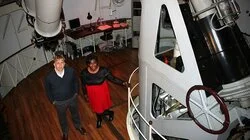
t is one of the most extraordinary space adventures in a generation - to land a spacecraft on a comet.The European Space Agency's (ESA) Rosetta spacecraft has been hurtling through space for over 10 years, tracking down a comet called 67P/Churyumov-Gerasimenko. Now it is about to do something that has never been attempted before and land a spacecraft on the comet's surface.This special episode of The Sky at Night puts the viewer right at the heart of the action, witnessing events as they happened from inside mission control. It reveals the latest images, explores the first groundbreaking science coming back from the comet and asks the astonishing questions that make this mission so captivating. Could Earth's water have come from comets? How do comets survive for so long? Could they have triggered the start of life on Earth?The journey has been fraught with risk and at every stage the comet seems to surprise, but if the mission succeeds it will be a momentous day in the history of space exploration.
 E11
E11
Perhaps no object in the night sky conjures up a greater sense of awe and wonder than a nebula. These vast clouds of dust and gases are stupendously beautiful, but they aren't just pretty objects. Nebulae play a key role in the birth and death of stars, and therefore in our own origins. And driving their creation is a kind of chemistry that the textbooks say shouldn't be happening.
 E1
E1
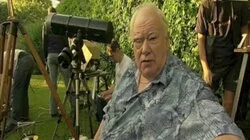
For more than half a century Sir Patrick Moore encouraged people to look up at the wonders of the night skies. Fittingly in this programme, recorded just before his death, he and his team offer advice to those who are discovering astronomy for the very first time. How should they set up their new telescopes and what should they seek out in the winter skies as they begin to share Sir Patrick's lifelong passion for the stars?
 E2
E2
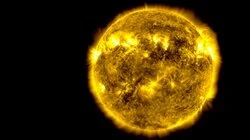
The sun is the monarch of the Solar System, but where does its kingdom end? At the furthest outposts, the two Voyager spacecraft are having a surprisingly turbulent time as they leave the sun's realm.The team are at the Royal Observatory, Greenwich, to see how the sun affects our planet. Solar physicist Dr Lucie Green joins them to enjoy the observatory's historic telescopes, which are still being used to gaze at the night sky.
 E3
E3
There are amazing astronomical objects to see in the winter night sky, and Sir Patrick Moore chose a few of them for his last Moore Winter Marathon. To find out how everyone got on, Chris Lintott and Lucie Green travel to the Kielder observatory in Northumberland to enjoy some of the darkest skies in Britain. Jon Culshaw joins them to take part in Patrick's final challenge, and the rest of the team set up their telescopes to try to catch an asteroid which is about to whizz past the Earth, closer than any before.
 E4
E4
Meteorites regularly hit Earth, although most go undetected. Occasionally a big meteorite collides with Earth and when it does, it can cause devastation. Lucie Green and Chris Lintott visit the Natural History Museum to look at its meteorite collection and discuss the recent Russian impact. Jon Culshaw goes on a meteorite hunt, while Pete Lawrence and Paul Abel give their beginners' guide on how to look at Saturn.
 E5
E5
Saturn is in our evening skies, and in any telescope looks a stunner. Lucie Green and Chris Lintott investigate the storm that is still raging in the planet's atmosphere, with the latest news from Saturn's amazing moons Titan and Enceladus.Pete Lawrence and Paul Abel illustrate Saturn's 'opposition effect' and look at some globular clusters, whilst Chris North gets a preview of the new eye-in-the-sky camera, soon to be fitted onto the International Space Station, which will image Earth in incredible detail.
 E6
E6
Stars are full of variety - they can be big or little, bright or dim. Our sun is right in the middle - Mr Average - but eventually it will grow old and become a red giant. Lucie Green and Chris Lintott discuss the lives of stars and what happens to them when they die.
 E7
E7
Every year thousands flock to Stonehenge to celebrate the summer solstice. Seeing the rise of the summer sun at Stonehenge is one of the most obvious connections between ancient man and the celestial calendar, but there is still fierce debate about possible links between this ancient site and the moon and stars. The team join in the solstice revelry and also launch the Moore Moon Marathon, with some easy things to look at on the moon over summer.
 E8
E8
Stars are full of variety - they can be big or little, bright or dim. Our sun is right in the middle - Mr Average - but eventually it will grow old and become a red giant. Lucie Green and Chris Lintott discuss the lives of stars and what is a golden era of exploration on Mars, with Nasa's space rover Curiosity finding out new and exciting things about the planet and which might offer the best chance of life elsewhere in our solar system.The spacecraft Mars Express is also celebrating a decade at the red planet and Chris Lintott and Lucie Green pick out some of the highlights, including the 'face of Mars'.Meanwhile Jon Culshaw explores the Moore Moon Marathon with astronomers in Chipping Norton.
 E9
E9
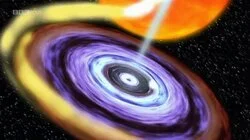
Black holes are the beating heart of galaxies. It seems that they are pivotal in their evolution, but they also have a destructive side. A dust cloud more massive than the size of the Earth is on a doomed course, as it careers towards the black hole at the centre of our galaxy. Chris Lintott talks to the Astronomer Royal about this cataclysmic encounter.
 E10
E10
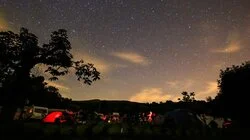
The team go camping at the Brecon Beacons star party and answer problems and queries about what to see in the night sky and how to use a telescope. Viewers have been sending in astronomy questions in the hundreds since the Space Surgery was launched six months ago.
 E11
E11
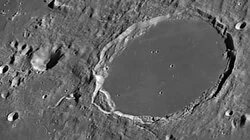
The moon is a most familiar sight in our sky - it is the astronomer's friend and was Sir Patrick Moore's favourite object - yet fundamentally we still do not know how it was formed and why its far side looks so different. The team join astronomers on Blackheath to watch a lunar eclipse; find out how everyone got on in the Moore Moon Marathon, the list of fascinating features you can see on the moon; and discuss the new missions that will explore this reassuringly familiar yet still most mysterious of cosmic satellites.
 E12
E12
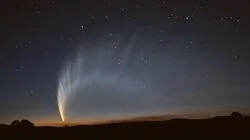
Astronomers always get excited about comets and in December they are looking forward to something rather special. The snappily-named Comet C/2012 S1 ISON has travelled from the very edges of our solar system on a one way ticket around the sun. As it heats up there is intense speculation about whether it will develop a beautiful tail or just break apart. On the Canary island of La Palma the team use both the Liverpool and Isaac Newton telescopes to go comet chasing.
 E1
E1
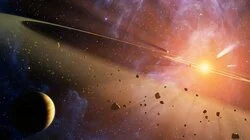
We now know there are other solar systems far away in space, but are they like ours and is there life on these strange worlds? Sir Patrick Moore goes on the quest for little green men.
 E2
E2
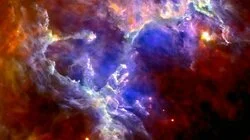
Space telescopes such as Herschel and Spitzer are peering at the dusty, dark cosmos and with their infrared eyes they can see the cold parts of the sky where stars are being born. Sir Patrick Moore discusses why the infrared is full of hidden delights, whilst Dr Chris North talks to Dr Amy Mainzer about NASA's infrared WISE telescope.
 E3
E3
Amateur astronomers are scanning the night skies looking for asteroids, comets and supernovae, and making vital discoveries in our quest for knowledge. Meanwhile space missions produce millions of images, but who is to say which ones are truly unusual and interesting? It is a job that computers struggle with, but one in which humans excel. This, more than ever, is the age of the amateur astronomer and Sir Patrick Moore explains how everybody can play a part whilst also enjoying the beautiful cosmos.
 E4
E4
Have you ever dreamed of travelling through space? Sir Patrick Moore takes us on an epic journey to the ends of our known universe, stopping en-route to take in the view. The team engage the warp drive and celebrate 55 years of The Sky at Night - at the speed of light.
 E5
E5
The Sky at Night celebrates 55 years with the second of its special programmes. Sir Patrick picked out 55 objects in the April sky and asked viewers to take part in his Moore Marathon. He finds out how everyone got on, with help from the team.
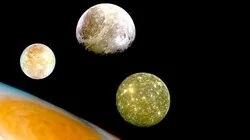 E6
E6
A European mission called JUICE has been announced which will visit Jupiter and its fascinating moons Europa, Callisto and Ganymede. Sir Patrick Moore finds out why these icy moons may harbour conditions suitable for life, and also has the latest news from the Cassini mission, currently sending back astounding images from Saturn.
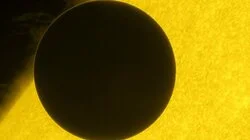 E7
E7
The Sky at Night travels to the Arctic Circle and the archipelago of Svalbard to see the Transit of Venus. This astronomical wonder, where the planet Venus passes in front of the Sun, is the last one in our lifetime; but as ever, the clouds test the team's nerves.
 E8
E8
Up and down the country amateur astronomers are out in their back-garden observatories looking at stars, galaxies and nebulae. The team visits some astronomers on their own turf, to find out what keeps them up late at night.
 E9
E9
The NASA rover, Curiosity, the size of a small car and nuclear-powered, landed on Mars in August and took its first view of the red planet. This ambitious mission hopes to find the building blocks of life as well as study the Martian climate and geology. Sir Patrick Moore discusses what Curiosity will be doing, as well as what to see in the September night sky.
 E10
E10
Sir Patrick Moore selects celestial objects to observe in the winter night sky and challenges viewers to spot as many as possible. In the second part of the year's Moore Marathon, Sir Patrick has selected two lists to suit astronomers of all abilities - objects that can be seen with the naked eye or binoculars, and more remote ones observable only by telescope.
 E11
E11
Sir Patrick Moore, Dr Chris Lintott and Dr Chris North find out what the universe is made of, from the 'dark matter' that shapes our galaxies to the infinitesimally small particles that make up atoms. Pete Lawrence and Paul Abel show how to use a planisphere as a guide to the night sky and what objects can be ticked off on the 'Moore Winter Marathon'.
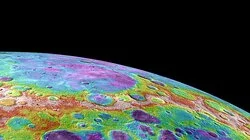 E12
E12
The tiny planet Mercury is in the morning sky and Sir Patrick Moore talks about the latest news from Messenger, the spacecraft which is over Mercury at the moment. Mercury is often compared to the moon, which was last visited by man in December 1972. Forty years on, Dr Chris Lintott looks at the legacy of that mission, Apollo 17, and what it has been able to tell us about the moon.
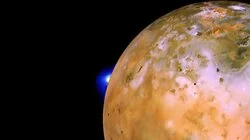 E1
E1
The planets and moons of our solar system are covered in volcanoes, some billions of years old and seven times the height of Mount Everest. Sir Patrick Moore discovers the havoc that volcanoes can wreak on our own planet, as well as elsewhere in our solar system.
 E2
E2
The great winter constellation of Orion is easily visible, with its ruby red star Betelgeuse and distinctive shape. It is also home to the Orion nebula, our nearest stellar nursery, where thousands of stars are being born. Sir Patrick Moore and the Sky at Night team take us on a tour of this magnificent constellation and its jewels.
 E3
E3
Sir Patrick Moore celebrates the 700th episode of The Sky at Night at his home in Sussex, with the help of special guests Professor Brian Cox, impressionist and amateur astronomer Jon Culshaw and Lord Martin Rees, the Astronomer Royal. A stellar panel of astronomers gathers to answer vexing questions from the viewers, while Sir Patrick has a close encounter with his younger self.
 E4
E4
Sir Patrick Moore joins an unlikely star party in the heart of London, where enthusiastic astronomers are cutting through the light pollution to see the planets and stars. Dr Chris Lintott also drops in on another star party - the 88th birthday celebrations for the nation's most famous astronomer.
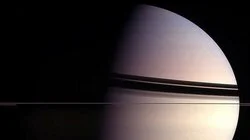 E5
E5
In the atmosphere of Saturn there is a gigantic storm, which is bigger than Earth itself. This month Sir Patrick Moore looks at the ringed planet, which can be seen in our night sky now. He talks to Paul Abel and Dr Chris North about these violent eruptions in the atmospheres of other worlds.And Jon Culshaw, Dr Lucie Green and Pete Lawrence travel to north Norway in search of the aurora borealis.
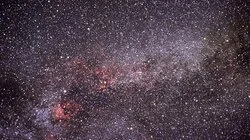 E6
E6
The summer constellation of Cygnus will soon be flying overhead in our night sky. With its rich array of nebulae and star clusters, it is a delight for astronomers to look at in the warm summer evenings. Sir Patrick Moore looks at the yellow star Albireo with its superb azure blue companion, while Chris North goes in search of the Milky Way.
 E7
E7
Sir Patrick Moore visits the South Downs Planetarium and discovers how the stars appeared to the ancient Egyptians, whilst Pete Lawrence explains what to look out for in the summer night sky.
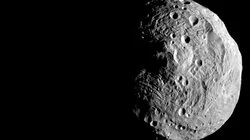 E8
E8
The Nasa spacecraft Dawn is getting up close and personal with the asteroid Vesta. Sir Patrick Moore discusses the first fly-by images of this most unusual asteroid, which will tell us more about how our solar system formed some 4.5 billion years ago. Paul Abel and Pete Lawrence their guide to the August night sky, including the return of the red planet Mars.
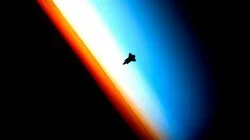 E9
E9
The future of manned space flight is entering an uncertain phase, our once vivid dreams of returning to the Moon and landing on Mars shattered by budget cuts and lack of will. This month on The Sky at Night, Sir Patrick Moore discusses the demise of the shuttle programme with astronaut Piers Sellers, whilst also going on an interstellar journey with Project Icarus, the visionary idea of how man might one day visit other worlds.
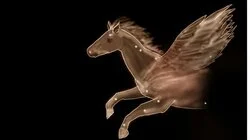 E10
E10
Two of the great autumn constellations of Andromeda and Pegasus will soon be gracing our night skies. The maiden Andromeda, chained to her rock, awaits her fate whilst the winged horse Pegasus gallops across the celestial skies. Full of interesting stars, nebulae and galaxies, these constellations are rich pickings for astronomers.
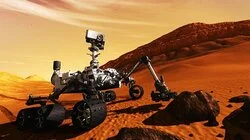 E11
E11
As Mars returns to the night skies, Sir Patrick Moore discusses its four faces. Dr Chris Lintott travels to Nantes in France to a world gathering of planetary scientists to find out about Curiosity - the NASA mission which will soon leave for the red planet, in search of signs of life.
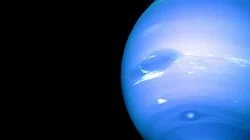 E12
E12
The outer limits of the solar system are a dark, cold and mysterious place, which only the Voyager spacecraft have visited. Sir Patrick Moore discusses the ice giants Uranus and Neptune, while Chris Lintott has an early Christmas treat - a lost episode of The Sky at Night from 1963 which has been returned to the BBC, in which Arthur C Clarke talks about his vision of bases on the moon and speculates when man will be on Mars.
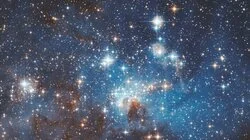 E1
E1
January provides the perfect opportunity to observe stars, planets and galaxies.Sir Patrick Moore takes us on a tour of the winter sky, looking at twinkling 'variable stars' with Dr John Mason, and at planets and galaxies with Pete Lawrence and Paul Abel.Sir Patrick and Dr Chris Lintott also point out the best objects to observe if you've had a telescope for Christmas.
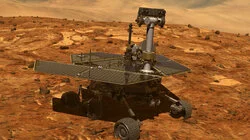 E2
E2
Mars is the brightest thing in the sky and is at its closest to Earth for the next four years. With NASA announcing that its Martian rover Spirit is to rove no more on the red planet, there is an interview with Prof Steve Squyres, the principal investigator of the Mars Exploration Rover Mission, about the attempts to get it out of the sand dune which ensnared it in May 2009 and the agonising decision to stop the rescue.
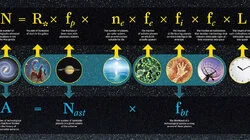 E3
E3
Half a century ago, scientists were speculating about the possibility of planets outside our solar system. Since then over 400 such extra-solar planets have been discovered. Is there anything living on them and if so, is it intelligent? Sir Patrick Moore debates the question of life in the universe with today's planet hunters and astrobiologists, while at the Royal Society Dr Chris Lintott searches for evidence of alien life.
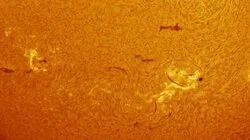 E4
E4
We can never see our nearest star at night, only by day. Looking at it directly will blind us - because our nearest star is the Sun. Sir Patrick Moore is joined by the Astronomer Royal for Scotland, Professor John Brown and by Dr Chris Davis. They take us on a tour of the Sun, Earth's primary source of energy and without which life would not exist. Pete Lawrence and Paul Abel demonstrate safe ways to look at the Sun from Sir Patrick's observatory in Sussex.
 E5
E5
Saturn is one of the largest planets and the beautiful system of rings surrounding it makes it the most distinctive in the solar system. But how were the rings formed and what effect do Saturn's many moons have upon them? Sir Patrick Moore is joined by Professor Michele Dougherty and Professor Carl Murray, while Pete Lawrence and Paul Abel demonstrate the best way to observe Saturn during May.
 E6
E6
The many star-forming areas of our galaxy are obscured by interstellar dust, but Herschel, a new space telescope, can see these areas in infrared light. Sir Patrick Moore is joined by Professor Derek Ward-Thompson and Dr Chris North to examine the latest stunning images from Herschel.Pete Lawrence shows what is on offer in the June sky and Paul Abel searches for a comet - but will he find it?
 E7
E7
The Space Shuttle Atlantis has returned from its final flight to the International Space Station. With the shuttle fleet soon to be decommissioned, Sir Patrick Moore and Dr Chris Lintott meet the crew of Atlantis to talk about the future of spaceflight, the legacy of the Space Shuttle - and how to prepare to go into space.
 E8
E8
Astronomers based in the UK have discovered the brightest and most massive star to date. But how did it get so big? Sir Patrick Moore and Chris Lintott are joined by one of the team who discovered the star, Dr Richard Parker.August also sees one of the most spectacular meteor showers of the year, and Pete Lawrence and Paul Abel explain the best way of observing the Perseids.
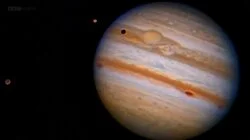 E9
E9
In July 2009 a large object crashed into Jupiter, and in May 2010 one of the most prominent features of the planet, the southern equatorial belt, disappeared. But where did it go? Sir Patrick Moore is joined by Dr John Rogers and Dr Leigh Fletcher to discuss the latest events on Jupiter. Pete Lawrence and Paul Abel observe the planet and explain what features can be seen through a telescope.
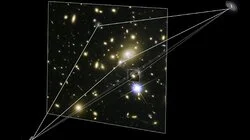 E10
E10
Light echoes are reflections of light from distant objects in space. But what do they look like and how can they best be seen? Sir Patrick Moore and his guests Professor Mike Bode and Dr Tim O'Brien explain all. Chris Lintott helps to construct a new radio telescope in Hampshire, while Pete Lawrence and Paul Abel preview what is on view in the October skies.
 E11
E11
Comets are strange and exotic objects, the remnants from dead stars and the birth pangs of our solar system. Only a handful of these ghostly, celestial objects have been seen at close quarters. Sir Patrick Moore discusses NASA's EPOXI mission, which hopes to rendezvous with comet Hartley 2.
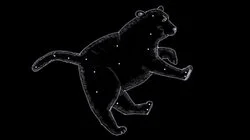 E12
E12
Ursa Major, the Great Bear, is a rich source of galaxies, double and variable stars and the Hubble Deep Field, through which we are able to look back 10 billion years in time. Sir Patrick Moore and his astronomical team give an intimate guide to one of the skies' most recognisable constellations.
Sir Patrick Moore charts the development of the telescope over four centuries and fasts forward to meet the astronaut who repaired the Hubble Space Telescope. Dr Chris Lintott visits some modern day astronomical leviathans.
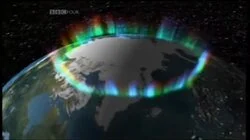 E2
E2
Referred to by the Scots as the Merry Dancers, the Aurora Borealis have caught the imagination of people across the globe.Dr Chris Lintott travels to a radar facility in northern Norway to discover how these magical lights are created, while Sir Patrick Moore discusses how our sun calls the tune for the Merry Dancers.
Saturn's mysterious moon Enceladus has startled astronomers with its amazing ice geysers, which spew out material into space. Sir Patrick Moore talks to the scientists who are trying to unlock the secrets of this tiny world.Dr Chris Lintott visits the Open University to find out the latest on our own Moon. He meets scientists from the Japanese Kaguya mission and the Indian Chandrayaan mission, with its British instrument CIXS.
Patrick Moore discusses what Herschel, Europe's biggest and most expensive space satellite, will do once it begins its infrared exploration of the universe.Dr Chris Lintott gets a rare chance to see the Herschel mirror, which at 3.5 metres will be the biggest astronomical mirror ever to be sent into space.
Every day, asteroids whizz past the Earth on their journey through space. Sir Patrick Moore discusses the chances of a close encounter with an asteroid, after telescopes recently got a unique view of an asteroid disintegrating in our atmosphere.
Containing trillions of stars, Andromeda is the largest galaxy in our neighbourhood. It is 2.5 million light years away, yet is still visible to the naked eye. Sir Patrick Moore and his guests unravel some of the mysteries in the star systems that surround us and look at the latest discoveries from our local galaxies.
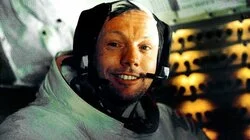 E7
E7
Using archive sound, satellite footage and film taken by the astronauts, Patrick Moore presents the story of mankind's first journey to another world.
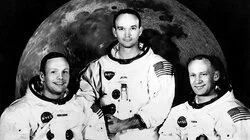 E8
E8
29th July 1969 witnessed the culmination of one of the greatest achievements in human exploration when man stepped on the moon. 40 years on, Sir Patrick Moore and his guests reminisce and celebrate the enormous achievements of the whole Apollo program.
 E9
E9
On 14th December 1972, Captain Eugene Cernan left the Moon to return to Earth. He had no idea that, 25 years later, he would still be the last man to have left his footprints on the lunar surface. Dr Chris Lintott travels to the Johnson Space Centre to talk to the Commander of Apollo 17 about his memories of being on the Moon. Sir Patrick Moore looks at lunar samples brought back by the astronauts and talks to NASA scientists about what they discovered.
 E10
E10
Sir Patrick Moore, with the help of Pete Lawrence and the latest pictures, investigates the longest total eclipse of the sun for many years, which took place in India and China in July 2009.In orbit around Saturn, the Cassini probe has sent back amazing new images, and there's a new discovery on the moon Enceladus. Chris Lintott reports from the latest Cassini conference in London and finds out why there is a sprinkling of table salt in the rings of Saturn.
 E11
E11
In July 2009, a mysterious large object crashed into Jupiter, the largest planet in the solar system, leaving behind a scar in the gas cloud the size of the Earth. Sir Patrick Moore examines this new feature with Jupiter experts John Rogers and David Rothery. Imaging experts Pete Lawrence and Paul Abel compete to capture the best images of the gas giant, while Chris Lintott has this month's news notes.
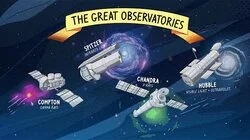 E12
E12
Following the Hubble space telescope's overhaul, Sir Patrick Moore and Chris Lintott examine its latest findings and the data from NASA's other telescopes, Spitzer and Chandra. Pete Lawrence observes the spiral galaxies M31 and M33 and explains how they owe their enigmatic names to an 18th-century French comet hunter.
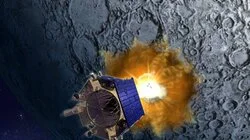 E13
E13
Observers now know there is water on the Moon, but how much? NASA's new LCROSS probe into the lunar surface will find out. Chris Lintott visits the Palomar observatory in California to witness the probe's impact, while Patrick Moore views it with friends from his home in Selsey. Can the Moon really support life?
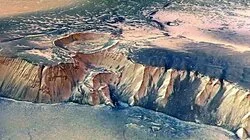 E14
E14
For centuries, astronomers, writers and philosophers have speculated about life on the planet Mars, but we have learned more about our near neighbour in the last 30 years than at any time in human history. Sir Patrick Moore and Chris Lintott explore the Red Planet.
 E15
E15
Winter is approaching, and with longer nights, it is the perfect time to get outside and enjoy the wonders of the night sky. Sir Patrick Moore is joined by Dr Chris Lintott and Pete Lawrence, plus a host of stargazers, in a search for the best that the winter skies have to offer.
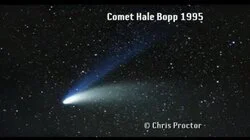 E1
E1
The Earth is bombarded by extra terrestrial material every day, but what is this cosmic debris? Sir Patrick Moore investigates comet tails, meteorites and asteroids and discovers the terrible consequences of a cosmic collision with the Earth. Also, the latest stunning images from Mars Express.
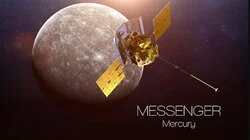 E2
E2
Star-gazing documentary series. Mercury is a world of extremes and enigmas - the closest one to the Sun. The spacecraft Messenger, which has just reached it after a four year journey, now offers enthralling pictures of its hidden side, which has never been seen before. Sir Patrick Moore looks at the latest images from this exciting mission, while Dr Chris Lintott looks forward to the lunar eclipse this month.
With a new era of lunar exploration dawning as more probes are launched to try to unlock the Moon's darkest secrets, Patrick Moore finds out about British ambitions to get there. Dr Chris Lintott travels to NASA to hear about plans to blast a crater in the lunar surface and and meets the astronauts who may be the next men on the Moon.
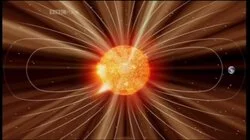 E4
E4
The world of astronomy with Patrick Moore. The start of a new solar cycle means the Sun's activity is about to hot up.
 E5
E5
Astronomy. Sir Patrick Moore celebrates the 666th edition of the programme by asking cosmologists exactly how much we know about the Universe.
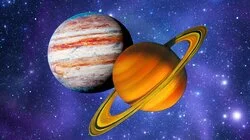 E6
E6
As NASA, along with the European Space Agency, plan a return mission to either Jupiter or Saturn, two prominent astronomers discuss which planet we should return to.The gas giants Jupiter and Saturn are magnificent and mysterious worlds, surrounded by moons which still perplex the astronomers with their strange appearance and incredible diversity. Europa, Jupiter's moon, offers the best chance yet of finding life elsewhere in our solar system, while Saturn's moon Titan, with its complex organic chemical lakes and a shore line uncannily like Cornwall, is now believed to be like the primeval Earth.
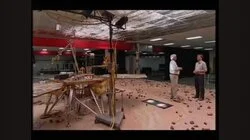 E7
E7
The NASA mission Phoenix has been on Mars a month and already there are images of the frozen ice caps, never before seen from a spacecraft on the Martian surface.Dr Chris Lintott travels to Tucson, Arizona, from where the NASA Phoenix team are operating the lander. He finds out how the spacecraft is doing and reports on the latest discoveries from the red planet.
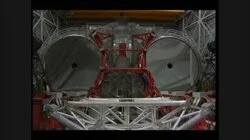 E8
E8
The Large Binocular Telescope in Arizona promises a revolutionary way to look at the night sky. The light from its two eight-and-a-half metre mirrors will produce images of unprecedented clarity and power, offering a glimpse beyond our solar system to the very beginning of time.Dr Chris Lintott visits Arizona to see the telescope first hand, while Sir Patrick Moore talks to the astronomers who will use it.
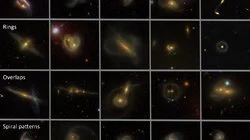 E9
E9
Sir Patrick Moore looks at the results of the Galaxy Zoo project, a website which sorts the galaxies of the Universe into spirals and ellipticals, which has been recorded by volunteers of the general public.Dr Chris Lintott talks to a Dutch schoolteacher who made a unique discovery whilst participating in the project.
 E10
E10
Sir Patrick Moore hosts an autumn equinox party in his garden and talks to Dr John Mason about what to look for in the night sky at this time of year.
 E11
E11
The world of astronomy. Gamma ray bursts are some of the largest explosions in the universe, and Sir Patrick Moore discovers how some of these monstrous events mark the spectacular deaths of the first stars.Also, Dr Chris Lintott visits the NASA Phoenix team fo find out the latest from the Mars Polar explorer.
 E12
E12
Patrick Moore wonders if there is life beyond Earth, while Chris Lintott spends the night with the giant Keck Telescope and meets alien hunter Dr Jill Tarter from SETI.
British-born astronaut Piers Sellers talks to Patrick Moore about life orbiting Earth and the future of the manned space programme. Chris Lintott talks about the space station and previews NASA's forthcoming rescue mission to Hubble telescope.
In this special programme, Patrick Moore celebrates the tremendous success of the Martian rovers Spirit and Opportunity and also the fleet of spacecraft now circling the red planet that are sending back astounding images in unprecedented detail.Chris Lintott reports from NASA's Jet Propulsion Laboratory in California about the new mission Phoenix, which goes to the polar regions of Mars later this year and Lucie Green visits the Mars Yard in Aberystwyth, where Europe's rover ExoMars is being put through its paces.
 E3
E3
Step outside and shining down in the evening sky is the planet Saturn. Bright and star-like, a small telescope will reveal its fabulous rings and some of the mysterious moons, including Titan. Chris Lintott advises on how best to see the loveliest of planets, whilst Patrick Moore finds out the latest from the Cassini mission which is currently orbiting Saturn.
In an anniversary programme, Patrick Moore travels back in time to see the first recording of The Sky at Night which took place 50 years ago, and then forward to 2057.
 E5
E5
Patrick Moore celebrates 50 years of The Sky at Night with friends of the programme including Terry Pratchett and Myleene Klass.
On our cosmic doorstep, a planet has been discovered which could be very similar to Earth. It's a discovery that has rocked the astronomical community. Sir Patrick Moore finds out more about this mysterious new world. Could it be a home from home?
 E7
E7
Sir Patrick Moore examines the summer constellation Scorpius, and locates our nearest black hole.
 E8
E8
Patrick Moore investigates Robonet, the robotic network of telescopes which spans the globe and links the cosmos directly to a laptop. In their world of permanent darkness these telescopes can react immediately to 'bangs in the night' - the exotic cosmic phenomena such as gamma ray bursts which are over in the blink of an astronomical eye.
 E9
E9
Sir Patrick Moore uses magic to explain the mysteries of black holes and the wonders of the Universe.
 E10
E10
Patrick Moore celebrates the 50th birthday of the radio telescope at Jodrell Bank in Cheshire, created just in time to pick up the radar signal from the satellite Sputnik. It has been at the centre of radio astronomy ever since and has been responsible for the discovery of quasars, gravitational lenses and groundbreaking research into pulsars and cosmic explosions such as supernovae. Astronomer Bernard Lovell talks about how it came to be built, despite huge engineering and financial challenges.
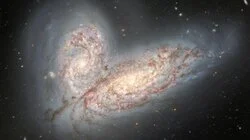 E11
E11
In two billion years' time our own Milky Way will collide with another galaxy, Andromeda, which will rip apart the fabric of both galaxies, destroying stars and planets and sparking a shockwave of fiery rebirth. Patrick Moore anticipates this far-off event and explains the role that 'dark matter' will play in this cosmic collision. Dr Chris Lintott steps outside to look at Andromeda, easily visible in the night sky using binoculars.
 E12
E12
In his garden, Patrick Moore is joined by Dr Brian May and Jon Culshaw to watch the cosmic firework display known as the Perseid meteor shower.
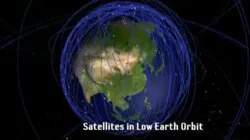 E13
E13
Dr Chris Lintott finds out how British technology is leading the way in satellite science, while Sir Patrick Moore investigates the threat from space debris that astronauts face in space.
 E14
E14
Dr Chris Lintott travels to the Johnson Space Centre to talk to the Commander of Apollo 17, Eugene Cernan, about his memories of being the last man on the Moon in 1972. Patrick Moore looks at lunar samples brought back by the astronauts and talks to NASA scientists about what they discovered.
Patrick Moore presents a retrospective of five decades of The Sky ay Night, recalling the history of space exploration from the first Russian Sputnik, the major astronomical discoveries over half a century, and the people he has met, from Orville Wright to Neil Armstrong.
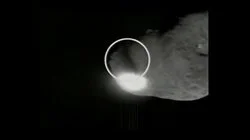 E1
E1
In and exclusive interview for The Sky at Night, Patrick Moore talks to Mike A'Hearn, the NASA scientist behind the spectacular Deep Impact mission. With amazing precision, he sucessfully designed an impactor to hir the fast moving coment Tempel-1. Its success has revealed new information about our Solar System.Also, the new Horizon mission will soon leave for the distant planet Pluto. Patrick Moore finds out more about this daring mission to thw edgo of our solar system and discusses whether Pluto is a planet or just another large Kuiper Belt object.
The volcanic mountain of Mauna Kea in Hawaii is home to some of the world's best astronomical obvervatories. At 14,000 feet, it's well above cloud level, giving astronomers the best view of the Universe they can get. Chris Lintott looks around the telescopes, whilst Patrick Moore speaks to the British Scientists who use them for their research.
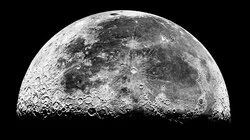 E3
E3
Patrick Moore presents a guide to the most familiar body in the night sky, whilst Chris Lintott gives tips on how to observe the moon.
With Saturn well situated in the night sky, Chris Lintott advises on what to look out for, while Patrick Moore talks to Professor John Zarnecki about the Cassini Mission.
Patrick Moore offers advice on how to observe the sun and its many brilliant features. Chris Lintott demonstrates how to split light into a spectrum.
A total eclipse of the Sun is a magnificent event. On 29 March 2006, Chris Lintott hopes to experience a Turkish delight, as a total eclipse of the Sun passes over the coastal resort of Antalya. In the UK, the Moon only partially blocks the Sun, but Patrick Moore hopes to catch a glimpse of one of nature's great events.
Look into the night sky and even with the naked eye you can pick out our nearest galactic neighbour, Andromeda, just one of the billions of systems which make up our Universe. Patrick Moore discusses how galaxies are formed and investigates just how we can trace their mysterious dark matter.Chris Lintott takes his telescope outside to give advice on where to find the brightest and the best galaxies, and what to look for.
The biggest and most powerful explosions in the Universe are gamma ray bursts. With the launch of the spacecraft Swift, scientists now realise these exotic phenomena are far more varied than first suspected. Sir Patrick Moore finds out about the biggest bangs since the 'Big' one, while Chris Lintott tracks down the supernova hunters.
Out of chas came order, as from the dust and gas of the very early Solar System emerged the gas giants. Four billion years ago our solar system looked quite different to the one we see today with Uranus and Neptune much closer to the Sun and regularly swapping orbits. Patrick Moore discusses how these wandering giannts came to be flung to the icy outer regions of our solar system whilst outside Chris Lintott takes a closer look at the largest of them all - Jupiter.
Britain is going back to Mars onboard the European ExoMars mission. UK scientists have a key role designing and building many of the instruments, including the innovative Life Marker Chip. In this special programme, Patrick Moore finds out how we hope to find Martian life whilst Chris Lintott goes in search of the rover that will be climbing mountains on Mars.
The lunar probe Smart-1 finishes its mission in September in spectacular fashion - by crashing into the Moon's surface. Patrick Moore talks to the project scientist Bernard Foing about its pioneering spacecraft technology and scientific successes.Also, two exciting missions will soon be on their way to the Sun: Stereo and Solar-B, both with important British science instruments onboard. Chris Lintott finds out more about the new ways we will be using to look at our nearest star.
With Autumn upon us, astronomers are looking forward to darker nights and the return of winter constellation of Orion. Patrick Moore gives his guide to what to look for over the coming months. Dr Lucie Green visits the autumn equinox star party at Kelling Heath and Chris Lintott talks to one of the founders of modern day cosmology, Professor James Gunn.
Venus was once thought to be the sultry home to a mysterious race of aliens. We now know it has searing temperatures, and a thick, caustic atmosphere. Patrick Moore discusses the latest findings of the European mission Venus Express which is currently scrutinising Earth's evil twin.
Stars are like bells, ringing out into space. Patrick Moore finds out how scientists are making sounds and music from the changes within stars. Chris Lintott steps outside and looks at variable stars, which make up the celestial orchestra.
The American and European spacecraft Cassini has been at Saturn now for six months. It has sent back fabulous images of the planet, its complex rings and many moons including the mysterious Titan. Patrick Moore discusses this and Cassini's probe Huygens, which will be sent to Titan on Christmas Day.
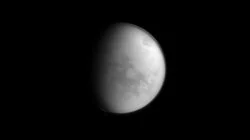 E2
E2
We have seen the surface of Titan, Saturn's moon and one of the most mysterious solar system bodies. Patrick Moore talks to the lead scientist of the Huygens surface science package (SSP), Professor John Zarnecki, about the first results from the probe. (2005)
Comets are thought to come from the Kuiper Belt beyond Pluto and the Oort Cloud at the very edge of our solar system. Little is known about this dark, far away home for comets. Patrick Moore debates the mysterious belts and the wandering strangers which escape from them. Also, the latest news from Mars, Saturn and the farthest regions of our Universe.
For the first time ever, Sir Patrick Moore has hosted a star party at his house in Selsey. Over two nights, amateur astronomers played lottery with the weather. Clouds, rain and fog played havoc with the viewing, but at last the night sky was revealed in all its glory.
In its 15 years, the Hubble Space Telescope has revolutionised astronomy with it's amazing insight into our Universe. Patrick Moore talks to Professor Gerry Gilmore about its highs and lows.Chris Lintott reports from the National Astronomy Meeting about the lastest finding on our Universe.
Sun spots and solar flares release high energy particles and radiation that can damage satellites and telecommunications, as well as creating the beautiful aurora in the atmosphere. Patrick Moore talks to Scottish astronomer Professor John Brown about the lastest solar mission, Rhessi, which is observing these incredibly violent outbursts from our nearest star, the Sun.
NASA are sending a probe into the comet 9P/ Tempel-1, early on the morning of 4 July 2005. This is a unique event, from which they hope to find out how comets are made. Are they balls of ice and mud, the harbourers of life's components, or just solid rocks of sterile cosmic debris? The Deep Impact programme hopes to provide the answers, but this destructive act is not without its critics. The Sky at Night explores the pros and cons of hitting a comet.
On 4 July NASA hopes to send an impactor into the comet 9P/Tempel-1. Patrick Moore talks to the world's leading comet experts about the fallout from this destructive act. Chris Lintott reports from Palomar Observatory in California, where astronomers will be eagerly watching the comet to see what happens when Deep Impact hits its mark.
The search for life elsewhere in our Universe has long been the Holy Grail for astronomers. Planets around distant stars have recently been discovered and we now realise that solar systems like our own could be widespread. So is life on Earth unique? With missions to Mars, Saturn's moon Titan and Jupiter's moon Europa, we could be nearing an answer. No definitive traces of life have been found elsewhere, but astronomers are probing ever deeper on our nearest planetary neighbours and across our Universe for the signitures of life. Patrick Moore discusses the issue with Professor Monica Gardy and Professor Simon Conway Morris.Chris Lintott spends a night meteor-watching with Dr John Mason, Martin Mobberly and Martin Andrews. Every year the Earth passes through dusty tail remnants of the comet Swift-Tuttle. These enter Earth's atmosphere-forming meteor showers called the perseids, this year they are at their maximum in mid-August.
Man is scanning the night sky and counting stars, galaxies and other solar bodies. Patrick Moore discusses two of the most comprehensive surveys - 2dF and the Sloan Digital Sky Survey - and asks what they tells us about our Universe. Chris Lintott visits the Palomar Observatory in Southern California. Patrck also ventgures into his gardne to look at the Perseids.
Its been an incredible year for the planets, with amazing discoveries and startling new insights into our Solar System. Earlier this month, astronomers from around the World converged on Cambridge to discuss the latest planetary research. Chris Lintott reports.
Mars is almost as close as it can get to Earth and better placed than it will be for many years. Patrick Moore throws a Mars party in his back garden to enjoy the exceptional views of the red planet. Chris Lintott reports from Madrid, where he witnessed the dramatic annular eclipse, also called 'the ring of fire'.
Our Sun is an ordinary star, but the celestial zoo contains stars as small as the Earth and others which are tens of thousands of times brighter. Patrick Moore takes a census and celebrates the tenth anniversary of the solar satellite Soho, which has produced spectacular images of flares, comets and sunspots the size of planets.
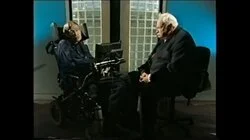 E7
E7
In this historic interview Patrick Moore talks to Professor Stephen Hawking about his cosmological theories and finds out how our Universe started.
 E1
E1
Patrick Moore presents the latest news on attempts to pick up radio messages from other worlds, with Ian Morison, co-ordinator of SETI in the UK.
 E7
E7
Astronomer and Queen guitarist Brian May joins Patrick Moore to discuss what people will be able to see during the total eclipse of the Sun on 11 August.
 E9
E9
A star that flares up where no naked-eye star has been seen before is termed a "nova". A nova is not new, merely a faint star which suffers a temporary outburst. Professor Chris Kitchin , joins Patrick to discuss these unpredictable stars.
 E11
E11
Patrick Moore tells the story of the "race" to discover Neptune, 150 years ago.
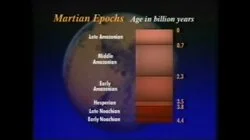 E13
E13
Recent meteorite findings in Antarctica, thought to have come from Mars, contained traces of primitive life forms. Dr Peter Cattermole, NASA scientist, helps describe the latest findings.
 E2
E2
Celestial names, discussed by Patrick Moore.
 E12
E12
Planets around Pulsars. Dr. Paul Murdin talks to Patrick Moore about the latest discoveries that suggest there may be planets associated with pulsars.
 E8
E8
The Giotto spacecraft encountered Halley's Comet in 1986 and escaped. Giotto recently made close-range studies of the comet Grigg-Skellerup. Patrick and Dr. John Mason are joined by Susan McKenna-Lawlor to discuss the problems of comets.
 E8
E8
The eclipse of the Moon, due on the early morning of 17 August, will be well seen from all over Britain. Patrick Moore talks about the eclipse, and H. J. P. Arnold explains how to take good photographs of it with an ordinary camera.
 E10
E10
Voyager 2, launched in 1977, has already passed by the giant planets Jupiter, Saturn and Uranus, all of which have provided plenty of surprises. Voyager has now passed Neptune, sending back remarkable new information about the outermost planet.Patrick Moore is joined by Dr Garry Hunt and other experts from the American team to summarise what has been discovered about this lonely, remote world. (1989)
 E6
E6
Most astronomers believe that the universe began with a big bang, perhaps 15 billion years ago, and that all the elements have since been built up out of the original hydrogen by being 'cooked' inside stars which have long since exploded.
 E1
E1
Patrick Moore talks about lunar eclipses, looking in particular at the eclipse of 6 January 1982, and describes features in the January night sky.
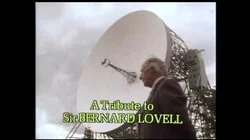 E11
E11
Tribute to Sir Bernard Lovell, recently retired as Director of the Radio Astronomy Observatory, Jodrell Bank. In this programme he talks to Patrick Moore about the radio telescope at Jodrell Bank.
 E5
E5
A look back at a Sky at Night episode from 1975. Uranus, Neptune and Pluto are all on view. Each has its own special points of interest and Patrick Moore talks about these remote members of the Sun's family.
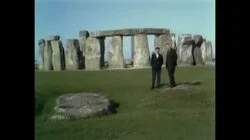 E7
E7
How much did our prehistoric ancestors know about the movements of the sun and moon? Patrick Moore is at Stonehenge to discuss the evidence that ancient monuments were built as observatories or eclipse computers.
 E11
E11
Many of the early Sky at Night programmes were destroyed or lost from the BBC library. Recently this early and very rare programme from 1963 with Arthur C Clarke, was discovered in an African TV station. Patrick and Arthur were both members of the British Interplanetary Society and here they discuss bases on the Moon and Mars. Arthur C Clarke made very few interviews, so this really is a broadcasting gem- once lost, but now found.
 E10
E10
First transmitted in 1960, Patrick Moore reviews the historic Soviet mission to launch a manned rocket into space and discusses with Gilbert Fielder, Director of the Lunar Section of the British Astronomical Association, the atmospheric conditions to be faced on the moon and the problems that could be solved by a successful landing of instruments there.